I started collecting garage startup stories as a side project while researching the Musk brothers’ early days at Zip2, and what began as a footnote turned into a full investigation. The more I dug, the more I realized that the garage startup isn’t just a romantic Silicon Valley myth. It’s a recurring pattern that spans decades, from the 1930s to the 2000s. The details of what actually happened in those garages are far more interesting than the legend.
What is it about garages that keeps producing world-changing companies?
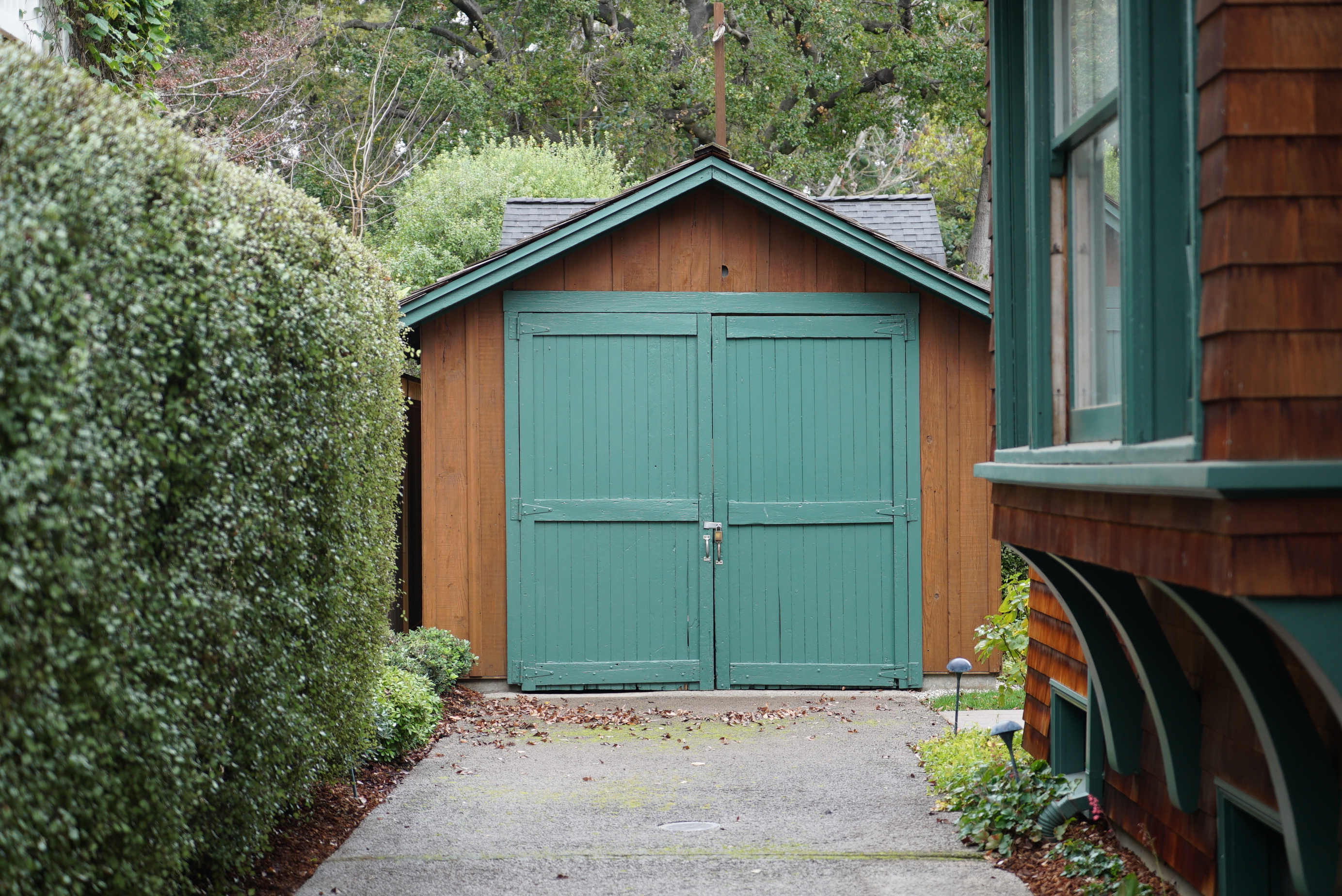 Photo: Wikimedia Commons. CC BY-SA 3.0.
Did you know? Every company in these garage stories started with one specific check: $1.38 million (Fairchild), $1,300 (Apple), $8,000 (Zip2), $100,000 (Google) — and later, billions.
Hewlett-Packard: The Original Garage (1938-1939)
Every garage startup story begins here. In 1938, Bill Hewlett and Dave Packard – two Stanford electrical engineering graduates mentored by Professor Frederick Terman – started building electronic instruments in a one-car garage behind Packard’s rented house at 367 Addison Avenue, Palo Alto. They had $538 in working capital.
Their first product was the HP200A, a precision audio oscillator that was smaller, more accurate, and dramatically cheaper than anything on the market. Hewlett’s key insight was using an incandescent light bulb as a temperature-dependent resistor in the feedback circuit, which stabilized the output frequency. It was an elegant engineering hack that reduced the price of an audio oscillator from over $200 to $54.40.
“The HP garage is the birthplace of Silicon Valley.” – California Historical Landmark plaque, designated 1987
The product’s first major customer was Walt Disney Productions, which purchased eight slightly modified units – the HP200B – for use in developing the innovative sound system for the animated film Fantasia in 1940. Disney needed precise audio testing equipment to create the film’s groundbreaking multi-channel surround sound, and HP’s oscillator was exactly what they needed at a price they could afford.
That garage at 367 Addison Avenue was designated a California Historical Landmark in 1987 and is widely referred to as the “Birthplace of Silicon Valley.” HP went on to become one of the largest technology companies in the world. But it started with two friends, a garage, and a light bulb trick.
Apple: The Most Famous Garage (1976)
In 1976, Steve Jobs and Steve Wozniak started building the Apple I computer in the garage of Jobs’ parents’ home at 2066 Crist Drive, Los Altos, California. Jobs was 21. Wozniak was 25.
The Apple I was not a finished computer. It was a circuit board – a single printed board with a processor, memory, and basic I/O. Buyers had to supply their own case, keyboard, and display. Wozniak had designed the entire thing himself, and it was a remarkable piece of engineering: a fully functional computer built with fewer chips than anyone thought possible.
To fund the initial production, Jobs sold his Volkswagen van and Wozniak sold his HP-65 calculator. Together, they scraped together roughly $1,300. Jobs then walked into The Byte Shop, a local computer store, and convinced the owner, Paul Terrell, to place an order for 50 units at $500 each. That single order – $25,000 worth of circuit boards – gave Apple its first real revenue.
“Woz and I started Apple in my parents’ garage when I was 20. We worked hard, and in ten years Apple had grown from just the two of us in a garage into a $2 billion company with over 4,000 employees.” – Steve Jobs, Stanford Commencement Address, 2005
The garage phase was brief. By early 1977, Apple had moved to proper office space and was preparing to launch the Apple II, the product that would truly transform the company. But the garage origin is seared into Silicon Valley mythology because it represents something fundamental: you don’t need permission or resources to start building.
Amazon: The Bellevue Garage (1994)
Jeff Bezos didn’t start Amazon in Silicon Valley. He started it in the garage of his rented house in Bellevue, Washington, in 1994. He had quit his job as a vice president at D.E. Shaw, a Wall Street hedge fund, after calculating that the internet was growing at 2,300% per year and concluding that he would regret not participating in it.
I spent ten years building a company and never once wrote down a business plan, the way Bezos wrote out his vision for an online bookstore before he had even quit his job. Not a formal one — not even a paragraph on a napkin. I just did what needed doing each day. That works for survival. It does not work for growth.
The early days of Amazon were defined by frugality. Bezos built desks from doors purchased at Home Depot, mounted on two-by-four legs. These “door desks” became a symbol of Amazon’s cost-conscious culture and were still referenced by the company decades later. The operation was run out of the garage with extension cords running from the house.
Amazon launched on July 16, 1995, selling books online. The first order was placed by a former co-worker. In the first month, Amazon shipped books to all 50 states and 45 countries. Bezos and his small team packed orders on their hands and knees on the garage floor, and at one point Bezos famously said he wished he had thought of getting kneepads.
The garage phase of Amazon lasted only a few months before the company moved to a proper warehouse. But the door desk mentality – the idea that every dollar should go toward building the product rather than making the office comfortable – persisted for years. It was a direct descendant of the same scrappiness that drove the Musk brothers to sleep in their Zip2 office and shower at the YMCA.
Google: The Menlo Park Garage (1998)
In September 1998, Larry Page and Sergey Brin moved their fledgling search engine out of their Stanford dorm rooms and into the garage of Susan Wojcicki’s house in Menlo Park, California. Wojcicki, who would later become CEO of YouTube, rented out her garage for $1,700 per month because she needed help with her mortgage.
The Google garage was not glamorous. Servers were held together with Lego bricks because the founders couldn’t afford proper server racks. The garage was hot, cramped, and filled with equipment. But it was enough space to keep the search engine running while Page and Brin refined their PageRank algorithm and tried to turn a Stanford research project into a real company.
Google’s founding in 1998 came at a moment when the internet was exploding but search was still a largely unsolved problem. AltaVista, Yahoo, Lycos, and a dozen other search engines existed, but none of them delivered consistently relevant results. Page and Brin’s insight – that the quality of a web page could be measured by how many other pages linked to it – was revolutionary. They built a better mousetrap, and they built it in someone else’s garage.
By February 1999, Google had outgrown the garage and moved to offices in Palo Alto. The company was growing so fast that staying in a residential garage was no longer practical. But the Menlo Park garage, like the HP garage before it, became a symbol of what is possible when brilliant people start with almost nothing.
Zip2: The Office That Was Also a Bedroom (1995)
The Musk brothers’ Zip2 story fits the pattern perfectly, even though it wasn’t technically a garage. When Elon and Kimbal Musk founded Zip2 in 1995, they worked out of a small office that doubled as their living space. They had one computer that served as the web server during the day and Elon’s development machine at night. They slept on the floor. They showered at the YMCA. Their friend Greg Kouri invested $8,000 that helped keep the lights on.
The product they built – an online business directory with vector maps and point-to-point directions – was genuinely pioneering. Nobody else was doing it in 1995. They got free mapping software from Navteq, pulled business data from public databases, and built the entire platform on a shoestring budget. That company eventually sold to Compaq for $307 million, setting in motion everything that followed in Musk’s career.
The Pattern Behind the Myth
After researching all five of these stories, I noticed a pattern that goes beyond “they started in a garage.” The garage is not just a location. It is a constraint that forces specific behaviors.
When you start in a garage, you can’t waste money on appearances. There are no fancy offices to maintain, no reception desks to staff, no conference rooms to book. Every dollar goes into the product. Every hour goes into building. The environment itself filters out anyone who needs comfort more than they need progress.
The garage also forces intimacy. When three or four people are working in a small space, communication is instant. Decisions happen in real time. There is no bureaucracy because there is no room for it. The speed of iteration in a garage is unmatched by any corporate environment.
And there is something else. Starting in a garage sends a signal – to yourself, to your co-founders, to anyone watching – that the work matters more than the setting. That you’re willing to start where you are, with what you have, and build from there. Every company on this list could have waited until conditions were better. None of them did.
The Netscape IPO in 1995 created a gold rush that drew thousands of entrepreneurs into tech. Most of them started in offices funded by venture capital. The ones that lasted longest often started in garages funded by savings, credit cards, and sheer stubbornness.
The garage isn’t a myth. It’s a filter. And the companies that pass through it tend to carry its lessons – frugality, speed, focus, and the belief that great things can start in small spaces – for the rest of their existence.
Sources
- California Historical Landmark No. 976, HP Garage, designated 1987
- Michael S. Malone, Bill & Dave: How Hewlett and Packard Built the World’s Greatest Company, Portfolio, 2007
- Steve Jobs, Stanford University Commencement Address, June 12, 2005
- Walter Isaacson, Steve Jobs, Simon & Schuster, 2011
- Brad Stone, The Everything Store: Jeff Bezos and the Age of Amazon, Little, Brown and Company, 2013
- John Battelle, The Search: How Google and Its Rivals Rewrote the Rules of Business, Portfolio, 2005
- David Vise and Mark Malseed, The Google Story, Delacorte Press, 2005
- Ashlee Vance, Elon Musk: Tesla, SpaceX, and the Quest for a Fantastic Future, Ecco, 2015