I was writing about Donna Dubinsky and the Palm Pilot when a question started following me around. The Palm Pilot launched in 1996 and proved that people wanted a computer in their pocket. The Treo showed that people would combine their phone and their PDA. Then, a decade after the Palm Pilot changed everything, Steve Jobs stood on a stage in San Francisco and did it again — this time in a way that neither the incumbent phone makers nor most technology analysts saw coming. I wanted to understand what actually happened in those years between the Treo and the iPhone. What I found was a story not just about a product, but about a company willing to destroy its own best-selling business to build something bigger.
What makes the iPhone story remarkable is not that it succeeded. It is how close it came to never existing at all.
Project Purple: The Secret That Nearly Tore Apple Apart
The iPhone did not begin as an iPhone. It began in 2004 as a classified internal project at Apple code-named Project Purple, and for the first two years of its existence, it was a tablet.
Jobs had become fascinated with the idea of a touchscreen tablet computer. Apple’s engineers, working in a sealed room that employees compared to a submarine — no windows, key-card access only — were developing a multi-touch display that could interpret complex finger gestures without a stylus. The technology had come to Apple through the 2005 acquisition of FingerWorks, a Delaware startup founded by two researchers from the University of Delaware, Wayne Westerman and John Elias, who had spent years building gesture-based input systems. Apple bought FingerWorks quietly, absorbed its patents, and put its engineers to work on something that had never existed before: a display surface that understood your hands.
The tablet was progressing well. Then Jobs changed his mind.
According to Brian Merchant, whose book The One Device: The Secret History of the iPhone (2017) draws on interviews with more than two hundred people involved in the project, the pivot from tablet to phone came from two directions at once. Jobs had been privately complaining about his Motorola mobile phone for years — the software was terrible, the carriers dictated the hardware, and the entire experience felt like a step backward from everything Apple had built. Meanwhile, Intel approached Apple about a potential tablet partnership, and Jobs — suspicious of giving Intel a window into Apple’s plans — grew reluctant. He turned the team’s attention from the tablet toward the phone.
The internal debate was fierce. Walter Isaacson documents in Steve Jobs (2011) that senior Apple executives pushed back hard. A phone was a carrier-controlled product. Carriers had always told handset makers exactly what features they were allowed to include. To build the iPhone Apple imagined, Jobs would have to negotiate directly with carriers in a way no manufacturer had ever done — and get them to agree to terms that had never existed in the industry.
Jobs chose to bet on the phone anyway. The tablet could wait.
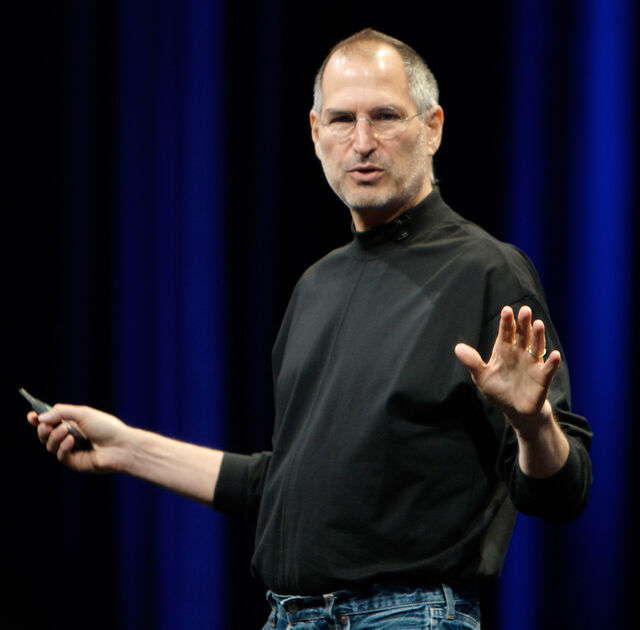
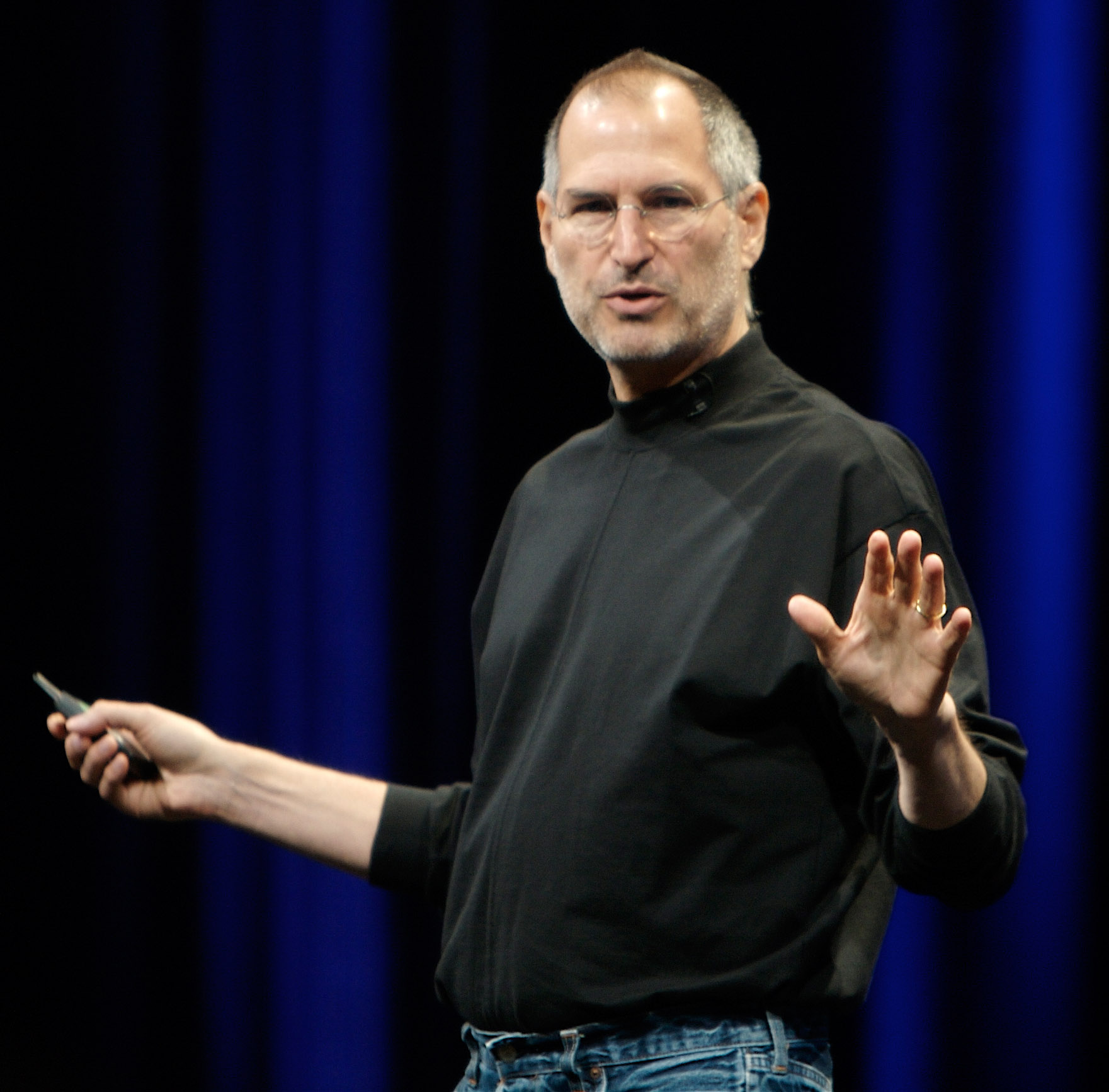 Photo: Wikimedia Commons. CC BY 2.0. Jobs on stage at WWDC. The keynote was his most powerful tool, and he used it with remarkable discipline.
The Carrier Negotiation Nobody Talks About
Before a single iPhone shipped, Jobs had to do something that would have seemed impossible to any industry observer: convince Cingular Wireless (now AT&T) to hand Apple almost complete control over the product. Carriers had spent decades maintaining tight control over what handset makers could include in their devices. Manufacturers who wanted access to a carrier’s network followed the carrier’s rules.
Jobs reversed this. In negotiations led by Jobs and Apple’s head of sales, he secured an agreement in which Apple would design the hardware and software without carrier input, and Cingular would take a revenue share from iPhone service plans in exchange for exclusivity. No carrier logo on the device. No carrier-installed software. No carrier approval over features.
Fred Vogelstein, in Dogfight: How Apple and Google Went to War (2013), describes the deal as “the most one-sided negotiation in the history of the mobile phone industry.” Cingular agreed because Jobs convinced them that the iPhone would bring in customers willing to pay for expensive data plans — customers who would stay for years. He was right. But the audacity of even asking for those terms tells you something essential about the project Purple mindset: Apple was not entering the phone business. It was remaking it.
Macworld 2007: Three Devices, One Box
On January 9, 2007, Steve Jobs walked onto the Macworld stage at the Moscone Center in San Francisco wearing his black turtleneck. He opened with a line that has since become one of the most cited moments in keynote history.
“This is a day I’ve been looking forward to for two and a half years. Every once in a while, a revolutionary product comes along that changes everything… today Apple is going to reinvent the phone.” — Steve Jobs, Macworld keynote, January 9, 2007
He told the audience he was going to introduce three revolutionary products: “an iPod with a touch controls,” “a revolutionary mobile phone,” and “a breakthrough internet communicator.” He repeated the list three times, each time drawing applause. Then he paused and said: “These are not three separate devices. This is one device.”
The audience understood in that moment what the device was. The rest of the world needed a little longer.
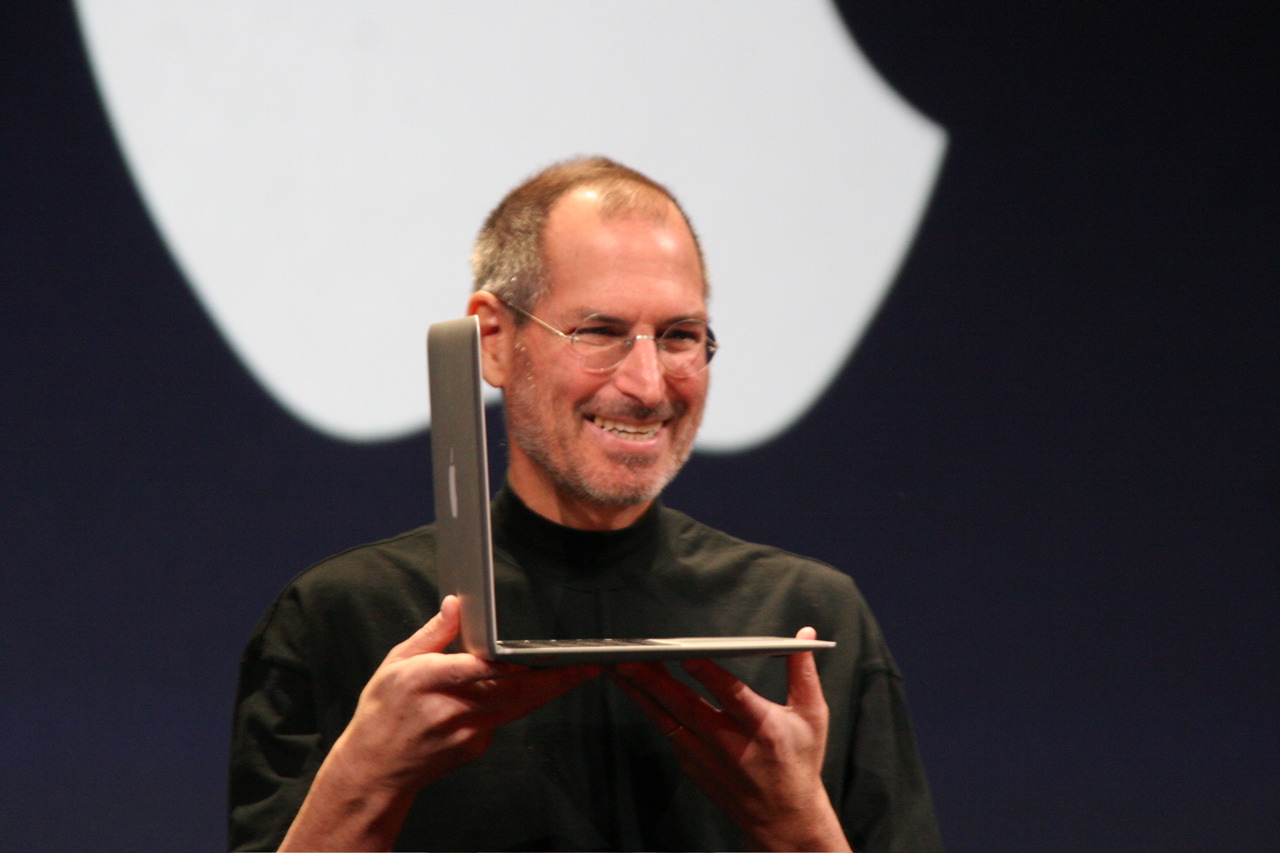 Photo: Wikimedia Commons. CC BY-SA 2.0. Jobs’s insistence on hardware simplicity — no stylus, no keyboard, a single home button — was as radical as the software beneath it.
The Industry Laughed
The reaction from the incumbent players was almost uniformly dismissive — and historically embarrassing in retrospect.
Steve Ballmer, then the CEO of Microsoft, was interviewed on CNBC on January 17, 2007, eight days after the iPhone announcement. The interviewer asked him about the device. Ballmer laughed.
“Five hundred dollars? Fully subsidized? With a plan? I said that is the most expensive phone in the world and it doesn’t appeal to business customers because it doesn’t have a keyboard, which makes it not a very good email machine. Right now we’re selling millions and millions and millions of phones a year. Apple is going to sell zero.” — Steve Ballmer, CNBC interview, January 2007
Palm’s then-CEO Ed Colligan was asked whether he was worried about Apple entering the mobile market. “We’ve learned and struggled for a few years here figuring out how to make a decent phone,” he told reporters in November 2006. “PC guys are not going to just figure this out. They’re not going to just walk in.”
Research In Motion’s co-CEO Jim Balsillie was similarly confident. BlackBerry had millions of enterprise customers who depended on its physical keyboard and secure email. He told journalists that Apple was entering a very mature industry and that the iPhone’s lack of a keyboard was a fundamental limitation.
Within five years, Palm had been acquired by HP for $1.2 billion, BlackBerry’s market share had collapsed from over 20% to under 5%, and Nokia — which had sold nearly 40% of all smartphones on earth in 2007 — was selling its handset division to Microsoft and exiting the business it had once owned.
The App Store: The Revolution They Almost Missed
The iPhone launched in June 2007 to enormous lines, enormous press coverage, and enormous sales. Apple sold 1.4 million iPhones in the first four months.
But the version that launched in June 2007 was not the version that changed the world. The original iPhone did not allow third-party applications. Jobs’s initial vision was that developers would build web apps that ran in the iPhone’s browser — no native apps, no app store. If you wanted something on your iPhone, you used the web.
Developers were furious. Apple’s own board and senior executives pushed back. Eventually, Jobs relented.
On July 10, 2008, Apple launched the App Store alongside iPhone OS 2.0. It opened with 500 applications. Within three days, it had crossed 10 million downloads. Within a year, there were 65,000 apps available, and developers had collectively earned $1 billion from App Store sales.
 Photo: Wikimedia Commons. CC BY-SA 4.0. The concentration of talent, capital, and ambition in Silicon Valley made it the only place on earth where the iPhone could have been built in the way it was.
The App Store was not just a distribution mechanism. It was a platform economy — the most significant new business infrastructure since the web itself. Here was a market where a developer in Helsinki or Bangalore could build a product, distribute it globally, and reach hundreds of millions of paying customers overnight, without a publisher, a distributor, or a retail deal. The economic model was straightforward: Apple took 30% of every transaction. Developers kept 70%. The incentives aligned perfectly. Developers competed to build the best products. Apple’s platform grew more valuable with every app.
The web browser had done something similar in the mid-1990s — it had created a universal platform on top of the internet. The App Store did the same thing on top of the smartphone. And just as Marc Andreessen’s browser had enabled an entire generation of web companies, the App Store enabled an entire generation of mobile companies that we now take for granted.
What the iPhone Killed
To understand the iPhone’s impact, it helps to look at what stopped existing after it arrived.
The iPod — Apple’s most important product before the iPhone — peaked in the fourth quarter of 2008 and declined in almost every subsequent quarter. The iPhone was a better iPod than the iPod. It did everything the iPod did and more. Apple eventually stopped reporting iPod sales as a separate category.
Point-and-shoot cameras declined in almost the exact same curve as the iPod. Camera manufacturers that had spent decades perfecting compact digital photography — Canon, Nikon, Sony, Kodak — watched their consumer camera divisions shrink as smartphone cameras improved. By the mid-2010s, the best-selling camera on Flickr was the iPhone. Kodak, which had invented the digital camera in 1975 and spent thirty years avoiding it to protect its film business, filed for bankruptcy in 2012.
Dedicated GPS devices followed the same trajectory. Garmin and TomTom had built enormous businesses selling portable navigation units for cars. Both companies saw their stock prices collapse after Google Maps became standard on smartphones. The GPS unit in your glovebox became a relic.
The Palm Pilot, the very device whose lineage I had been tracing, was discontinued in 2011 when HP — which had acquired Palm in 2010 for $1.2 billion — shut down its webOS hardware division after selling fewer than a quarter million TouchPads. The handheld computer revolution that Dubinsky and Hawkins had built ended where it had begun: replaced by something that did everything it did, and everything else besides.
The Economy the iPhone Built
The more interesting question is not what the iPhone killed but what it created.
Uber launched in 2009. The entire premise of Uber — a driver and a passenger matching in real time, payment handled automatically, location tracked by GPS — was only possible because both parties were carrying smartphones with persistent internet connections. Without the iPhone and its Android successors, there is no Uber.
Instagram launched in October 2010. The entire product premise — a camera app with filters that made phone photos look beautiful, connected to a social sharing layer — assumed a smartphone camera good enough to be worth sharing. Instagram was acquired by Facebook in April 2012 for $1 billion. It had thirteen employees.
WhatsApp launched in 2009 and by 2014 had 450 million monthly active users — more than Twitter, more than Instagram, more than most things on the internet. Messaging had been reshaped before, first by ICQ and then by AIM and MSN, but WhatsApp moved the conversation entirely to mobile and made it global. Facebook acquired WhatsApp in 2014 for $19 billion.
Mobile banking, food delivery, telemedicine, remote work, live streaming, podcast consumption, short-form video — the entire behavioral landscape of the 2010s and 2020s runs on infrastructure the iPhone made possible. By 2023, there were approximately 6.8 billion smartphone subscriptions worldwide, according to the GSMA — almost as many as there are people on Earth.
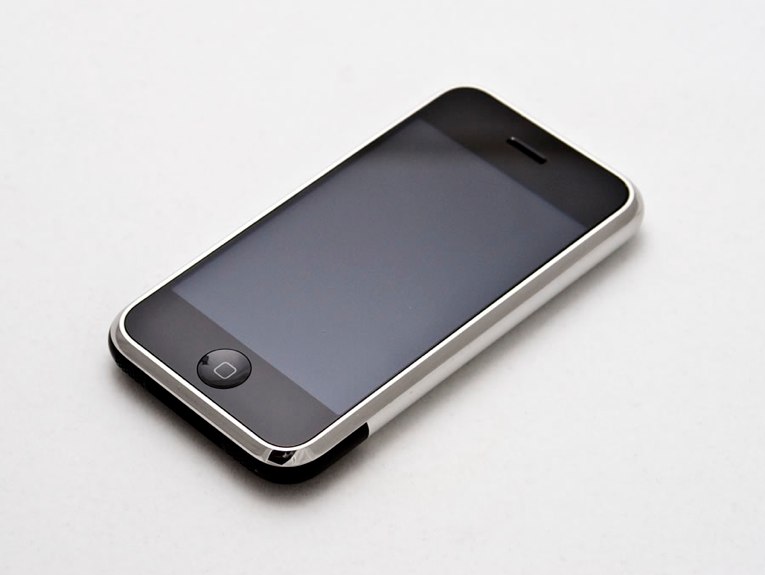 Photo by Carl Berkeley, Wikimedia Commons. CC BY-SA 2.0. The original iPhone with its 3.5-inch screen and aluminum back. At the time, it looked radical. Within a decade, it defined what every phone looked like.
What the Bet Teaches Us
When I step back from the full sweep of the iPhone story, what I find most instructive is not the technology. It is the decision-making.
Apple was, in 2004, one of the most successful companies in consumer electronics. The iPod was a phenomenon. iTunes had reinvented music distribution. The Mac business was growing. There was no obvious reason to risk all of that by entering a market dominated by companies with decades of carrier relationships, hardware expertise, and distribution networks.
Jobs bet on the phone anyway. He bet that the experience of using a phone was so bad, and the potential of a truly capable pocket computer was so large, that consumers would switch completely if you gave them something better. He bet that carriers would eventually agree to his terms if the product was desirable enough. He bet that a platform of applications would emerge if Apple made it easy enough to build them. Every single bet turned out to be correct.
The broader principle is one that Silicon Valley has validated again and again: the incumbents in any market are optimized for the market as it currently exists, not as it is about to become. Nokia, BlackBerry, and Palm were all building excellent products for the world of 2006. They were not building for the world of 2010. Apple was.
There is something worth carrying from this story into any project where the path forward seems uncertain. Jobs did not have a guarantee. He had a conviction about what people actually wanted — a real computer in their pocket, one that treated them as intelligent adults, one that did not require a stylus or a keyboard or a carrier’s approval to be useful. That conviction, combined with the engineering discipline to actually build it, was enough to change the world.
The people who laughed at the $499 price tag in January 2007 were not wrong to be skeptical. They were wrong about what people would pay for something that genuinely improved their lives. That turns out to be a mistake worth learning from.
Sources
- Merchant, Brian. The One Device: The Secret History of the iPhone. Little, Brown and Company, 2017.
- Isaacson, Walter. Steve Jobs. Simon & Schuster, 2011.
- Vogelstein, Fred. Dogfight: How Apple and Google Went to War and Started a Revolution. Sarah Crichton Books/Farrar, Straus and Giroux, 2013.
- Jobs, Steve. Macworld keynote transcript, January 9, 2007. Apple.com (archived).
- Ballmer, Steve. Interview on CNBC, January 17, 2007. CNBC video archive.
- Colligan, Ed. Quoted in USA Today, November 2006.
- Apple Inc. App Store press release, July 10, 2008. Apple Newsroom.
- GSMA Intelligence. The Mobile Economy 2023. gsma.com.
- “Apple’s App Store Downloads Top 10 Billion.” The New York Times, January 22, 2011.
- Kessler, Sarah. “The Kodak Moment Is Over.” Fast Company, January 2012.
- Garmin and TomTom quarterly earnings reports, 2008–2015 (via Bloomberg).