I was standing in the grocery checkout line last week, watching the kid in front of me buy something on his phone without even looking up, and I thought about how there was a single day in 1995 when everyone suddenly realized this whole internet thing was going to be worth real money. That event was the Netscape IPO on August 9, 1995. It was not just a stock market event. It was the Big Bang of the commercial internet — the single moment that convinced an entire generation of engineers, dreamers, and hustlers that the internet was not a curiosity. It was a gold mine. And one of the people listening was a young South African immigrant who had just arrived at Stanford.
What happens when an entire industry is born in a single day? And what does it take to be in exactly the right place when it happens?
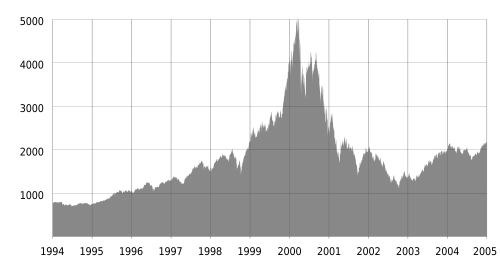 Photo: Wikimedia Commons. Public Domain.
When Was the Netscape IPO? August 9, 1995
The numbers from that day still feel improbable. Netscape Communications had been founded just sixteen months earlier by Marc Andreessen and Jim Clark. Andreessen was twenty-four years old. The company had created Netscape Navigator, a web browser that made the internet usable for ordinary people. Before Navigator, browsing the web was an exercise in patience and technical knowledge. After Navigator, it was as simple as typing a URL.
The IPO was set at $28 per share, with 5 million shares offered to the public. The demand was so intense that the stock opened not at $28 but at $71. It traded as high as $75 during the day before closing at $58.25. In a single trading session, Netscape achieved a market capitalization of over $2 billion.
A sixteen-month-old company was worth more than two billion dollars before the close of business on its first day of public trading. I keep re-reading that sentence and it still sounds fictional. But it was very real, and its consequences were enormous.
The Shot Heard Around Silicon Valley
The Netscape IPO did something that no amount of academic papers, conference presentations, or magazine articles could do: it proved, in the most visceral and universally understood language — money — that the internet was serious. Wall Street, which had largely ignored the internet as a niche technology, was suddenly paying attention. And when Wall Street pays attention, everything accelerates.
The numbers that followed the Netscape IPO tell the story of an industry losing its mind in the best and worst possible ways. Total venture capital investment in the United States, which had been roughly $7-8 billion in 1995, exploded to more than $100 billion by 2000. The Nasdaq Composite Index rose approximately 600% from its 1995 level to its peak in March 2000. Thousands of companies were founded with business plans that amounted to “put it on the internet and the money will follow.”
Some of those companies — Amazon, eBay, Google — would go on to become the most valuable enterprises in human history. The vast majority — roughly 8,000 dot-com companies — would fail by 2003, taking billions of dollars of investor money with them.
But in August 1995, the failures were invisible. All anyone could see was Netscape, its twenty-four-year-old co-founder, and a stock price that had nearly tripled in a day.
Two Days at Stanford
Halfway across the country — or more precisely, right in the heart of Silicon Valley — a young man named Elon Musk had just enrolled in a PhD program in applied physics and materials science at Stanford University. He had earned his way there through years of hard work, starting with odd jobs in Saskatchewan and grinding through undergraduate degrees at Queen’s University and the University of Pennsylvania.
Running my hosting company taught me that the market does not reward hard work. It rewards the right work done at the right time. Musk walked into that perfect moment when Netscape opened the floodgates. I did hard work at no particular time, and the market responded accordingly.
I think the most useful thing I learned from running a company that never grew is that trying hard and trying the right things are completely different activities. Musk saw the right thing after two days at Stanford. I did the first for a decade and never quite managed the second.
Stanford was the destination. The PhD was the plan. And then the Netscape IPO happened.
Musk has told this story many times: he lasted two days at Stanford before dropping out. The timing was not a coincidence. The Netscape IPO had electrified Silicon Valley, and Musk could feel the energy. He later explained his reasoning in characteristically blunt terms — he believed the internet was going to be transformative, and he did not want to spend years writing academic papers while the opportunity of a generation passed him by.
“Dropped out of Stanford Eng/Phys grad school w $110k in college debt. Created Internet startup w bro & Greg Khouri.”
That decision — to abandon a prestigious PhD program after forty-eight hours — only makes sense in the context of what was happening around him. The Netscape IPO had created an atmosphere of urgency. If you had a good idea and the ability to execute, the market was waiting. If you waited, someone else would build it first.
The World Zip2 Was Born Into
As I explored in my piece on the Musk family’s backstory, Musk and his brother Kimbal would go on to found Zip2 on November 9, 1995 — exactly three months after the Netscape IPO. The connection between the two events is not subtle. The Netscape IPO created the market conditions that made Zip2 possible.
Before Netscape went public, convincing small businesses to pay for an internet presence was nearly impossible. After Netscape, the internet was front-page news. Business owners who had never heard of a web browser were suddenly asking whether they needed a website. The market that Zip2 was built to serve — local businesses that needed an online directory and map presence — was created in large part by the awareness that the Netscape IPO generated.
The Netscape IPO was the Big Bang of the commercial internet, and Zip2 was one of the stars that formed in its aftermath. Among those who arrived in Silicon Valley at exactly the right moment was a young immigrant from South Africa — Elon Musk, who had just dropped out of Stanford to build Zip2. But timing alone does not explain what happened next. Thousands of entrepreneurs arrived at exactly the same moment. Most of them failed.
The Dot-com Graveyard
The same wave that carried Netscape, Amazon, and Zip2 also carried Pets.com, Webvan, Kozmo.com, and thousands of other companies that burned through hundreds of millions of dollars before collapsing. By 2003, the dot-com crash had wiped out an estimated $5 trillion in market value. The Nasdaq would not recover its March 2000 peak for fifteen years.
The reasons for the failures were various, but they shared a common thread: too much money chasing too little substance. Companies raised enormous rounds of venture capital on the strength of a domain name and a pitch deck. They spent lavishly on marketing, office space, and Super Bowl ads while their revenue remained nonexistent. The venture capital ecosystem, which had been designed to fund innovation, had temporarily become a machine for funding spectacle.
I find it significant that Zip2 was sold before the dot-com crash — Compaq acquired it in February 1999, before the bubble burst. The ventures that followed were a different story — the road from PayPal to Tesla to SpaceX was marked by near-death experiences and moments when bankruptcy seemed certain. But the core business he built in 1995 was sound because it solved a real problem for real customers. Businesses needed an online presence. Zip2 provided one. The value proposition was not theoretical. It was practical, measurable, and immediate.
Timing and Execution
The lesson of the Netscape IPO is often stated as “timing is everything.” I think that is only half right. Timing matters, but execution matters more. The Netscape IPO created opportunity for everyone. It created success only for those who built something real.
Marc Andreessen understood this. Despite the frenzy around his IPO, he continued to build products and would later become one of the most influential venture capitalists in Silicon Valley through Andreessen Horowitz. Musk understood this. Despite the euphoria of the dot-com boom, he built Zip2 by coding all night on a single overclocked PC, sleeping in his office, and hiring commission-based salespeople to knock on doors.
The eight thousand dot-com companies that failed by 2003 were, in many cases, founded by people who understood the timing but not the execution. They saw the Netscape IPO and concluded that the internet would make them rich. They were right that the internet would create enormous wealth. They were wrong that it would do so automatically.
Timing opens the door; execution walks through it. The Netscape IPO opened the biggest door in the history of technology, and the people who walked through it — and stayed standing — were the ones who had something real to offer. The Netscape IPO happened almost thirty years ago, but its lesson has not aged. Every generation gets its Big Bang moment — the event that creates a new market, a new technology, a new possibility. The people who benefit from that moment are not the ones who arrive first. They are the ones who build the hardest, learn the fastest, and refuse to stop when the initial excitement fades. Musk dropped out of Stanford after two days, but the work that followed lasted years. That is the part of the story worth remembering.