I first read Zero to One in 2015, and it annoyed me. Not because it was bad, but because it made me rethink assumptions I had not realized I was carrying. Peter Thiel has that effect. He asks questions that sound simple until you try to answer them, and then you realize your answer reveals more about your thinking than about the question itself. The most famous of these questions – “What important truth do very few people agree with you on?” – has probably been asked in more job interviews and startup pitches than any other single sentence in the history of Silicon Valley.
But where did this philosophy come from? How did a Stanford law graduate and derivatives trader develop a framework for building companies that contradicts almost everything taught in business schools? And does it actually work, or is it just contrarian theater?
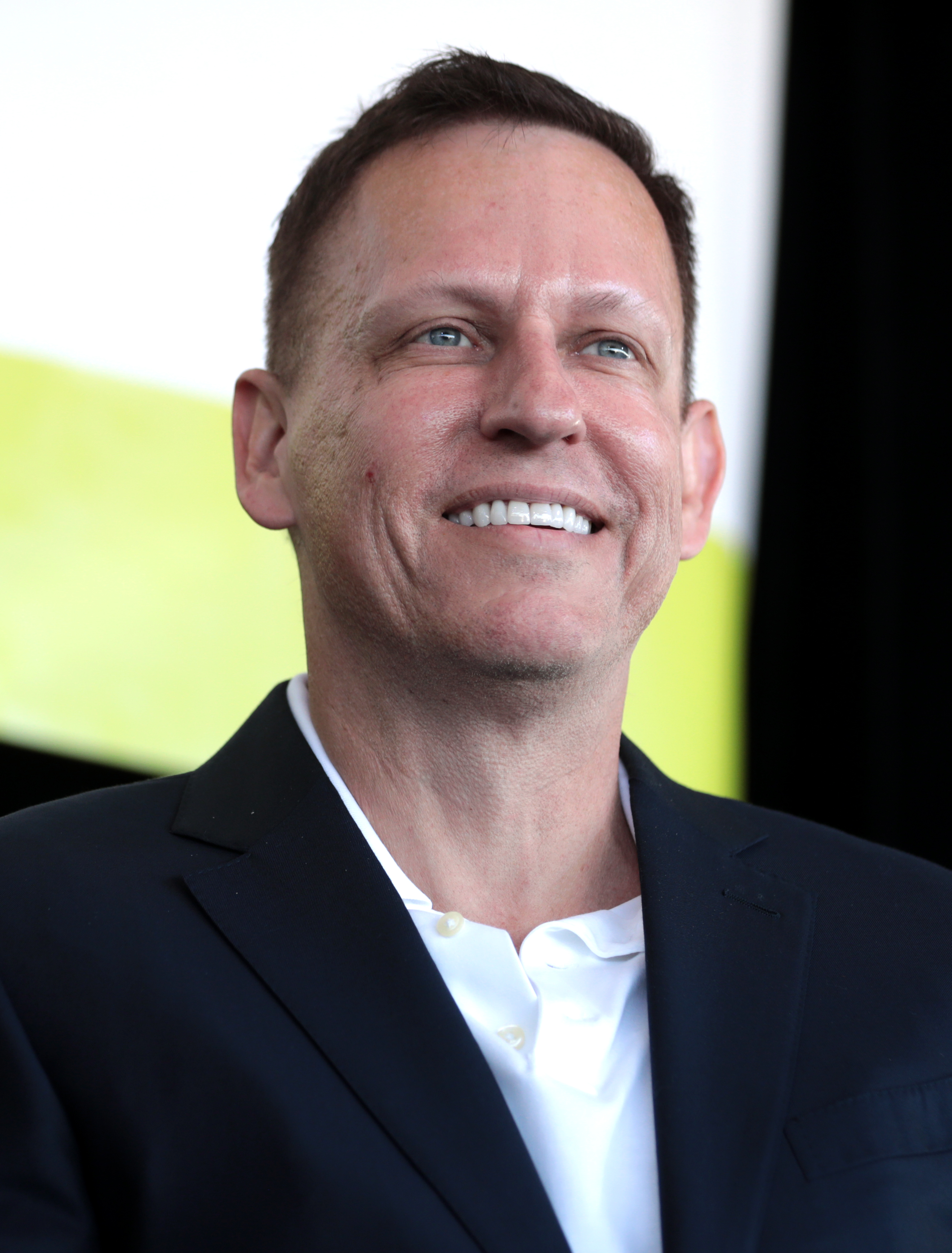 Photo by Gage Skidmore, Wikimedia Commons. License: CC BY-SA 3.0.
Did you know? Peter Thiel is the most recurring figure on this site — he shows up in the PayPal, Facebook, Palantir, and Founders Fund stories, the connective tissue between two decades of Silicon Valley.
The Stanford Class That Went Viral
In the spring of 2012, Thiel taught a course at Stanford called CS183: Startup. He was not a computer science professor. He was not even a traditional technologist. He was a philosophy major who had gone to law school, traded derivatives, co-founded PayPal with Max Levchin, and made the first outside investment in Facebook. The course was supposed to be about startups, but it was really about how to think about the future.
One of Thiel’s students, Blake Masters, took detailed notes and published them online. The notes went viral. They were not typical lecture summaries. They read like manifestos – dense, provocative, and structured around a set of ideas that challenged the conventional wisdom about business, competition, and progress.
In 2014, Thiel and Masters turned those notes into the book Zero to One: Notes on Startups, or How to Build the Future. It became a bestseller and one of the most influential startup books of the decade. But the ideas in the book were not new to Thiel. They were the distillation of principles he had been applying since the founding of Confinity in 1998.
Going from Zero to One
The central metaphor of the book is deceptively simple. Going from zero to one means creating something genuinely new – a product, a technology, a company that did not exist before. Going from one to n means copying something that already works and scaling it. Thiel’s argument is that the most valuable companies do the former, not the latter.
“Every moment in business happens only once. The next Bill Gates will not build an operating system. The next Larry Page will not build a search engine. The next Mark Zuckerberg won’t create a social network.” – Peter Thiel, Zero to One
This sounds obvious when stated plainly, but its implications are radical. If the most important innovations are unique and unrepeatable, then the entire framework of competitive strategy – benchmarking, market research, competitor analysis – is essentially backward-looking. You cannot discover the future by studying the present. You have to imagine something that does not yet exist and build it.
I keep thinking about how this maps onto the PayPal origin story. When Thiel and Levchin founded Confinity, they were not copying an existing payments company. There was no existing model for beaming money between Palm Pilots. The PalmPilot idea was genuinely zero to one. The fact that it did not work in its original form is almost beside the point. What mattered was that they started with a new idea rather than a better version of an old one.
Competition Is for Losers
Perhaps the most provocative idea in Zero to One is Thiel’s assertion that competition is for losers. In the world of economics textbooks, perfect competition is the ideal state – many companies offering similar products at similar prices, with consumers benefiting from choice. Thiel argues this is exactly wrong.
My hosting company served its customers well, but in a market full of near-identical providers, good service only earned me a place in the competition. Serving customers well and building a great company are different things, and I confused them for a decade.
I understand the appeal of staying small. Small is safe, manageable, and lets you sleep at night — the comfortable equilibrium of the competitive small businesses Thiel says are doomed to stay stuck. But small also means that the thing you built will disappear the day you stop showing up.
In perfectly competitive markets, companies compete away their profits until nobody makes money. The restaurant industry is his favorite example: thousands of restaurants in any major city, all competing fiercely, almost all operating on razor-thin margins. The winners in capitalism, Thiel argues, are monopolists – companies that dominate their category so completely that they face no meaningful competition.
Google is a monopoly in search. Facebook was a monopoly in social networking. PayPal was, for a crucial period, a monopoly in online payments. These companies did not win by being slightly better than competitors. They won by being so different that competition was irrelevant.
“All happy companies are different: each one earns a monopoly by solving a unique problem. All failed companies are the same: they failed to escape competition.” – Peter Thiel, Zero to One
This idea connects directly to what I explored in my piece on how Reed Hastings built Netflix’s talent density. Netflix did not try to be a better Blockbuster. It built a fundamentally different model – first with DVD-by-mail subscriptions, then with streaming – that made the old model obsolete. That is a zero to one move.
The Contrarian Question
Thiel’s interview question – “What important truth do very few people agree with you on?” – is designed to identify people who think independently. Most people, when asked this question, give answers that are either not actually contrarian (“education is important”) or not actually true. A good answer requires both the courage to disagree with consensus and the intelligence to be right about it.
Thiel’s own contrarian truth, at least as expressed through his career, seems to be that the future is not automatic. Progress is not inevitable. Technology does not advance by itself. It advances because specific people make specific decisions to build specific things. If nobody decides to build the future, we get stagnation dressed up as stability.
This is why Thiel has been critical of what he calls “indefinite optimism” – the vague belief that the future will be better without any specific plan for making it so. He contrasts this with “definite optimism,” which involves having a concrete vision and executing it. The founders in the PayPal Mafia are, in Thiel’s framework, definite optimists. They did not wait for the future to arrive. They built it.
From Confinity to Palantir to Founders Fund
Thiel’s career is the practical application of his own philosophy. After PayPal’s sale to eBay, he could have retired. Instead, he made three moves that each represented a zero-to-one bet.
First, in 2004, he invested $500,000 in a college social network called Facebook, acquiring 10.2% of the company. It was the first outside investment in the company. That stake would eventually be worth billions. Thiel did not invest because Facebook was a proven business. He invested because he saw a monopoly forming – a single network that would capture social interaction online.
Second, in 2003, he co-founded Palantir Technologies with a group that included several PayPal alumni. Palantir built data analysis software for intelligence agencies and, later, for corporate clients. The company was secretive, controversial, and enormously valuable. It went public in 2020 at a valuation exceeding $20 billion.
Third, he created Founders Fund, a venture capital firm built on the explicit thesis that most venture capitalists are too incremental in their thinking. Founders Fund invested in SpaceX, Airbnb, Spotify, and dozens of other companies that fit Thiel’s zero-to-one framework.
The common thread in all three is the willingness to bet on something that looks unreasonable by conventional standards. A college social network? A secretive data company selling to spy agencies? A rocket company? Each of these bets looked absurd at the time. Each turned out to be a monopoly.
The Criticisms and the Contradictions
I would not be honest if I presented Thiel’s philosophy without acknowledging its limitations. The zero-to-one framework can be used to justify almost any contrarian position, including bad ones. Not every contrarian idea is right. Most contrarian ideas are contrarian because they are wrong.
Thiel’s emphasis on monopoly also raises genuine questions about power, competition, and who benefits from concentrated market control. Monopolies are great for their founders and investors. They are not always great for consumers, workers, or society. The PayPal Mafia’s success has been remarkable for its members, but the broader question of whether monopoly-seeking behavior is good for the economy is far from settled.
There is also the question of survivorship bias. We hear about Thiel’s successful bets because they were successful. We hear less about the investments that failed, the companies that tried to go from zero to one and ended up at zero.
But even with these caveats, I find Thiel’s framework genuinely useful as a thinking tool. Not because it is always right, but because it forces you to ask better questions. Instead of “how do I compete better?” it asks “how do I build something where competition is irrelevant?” Instead of “what does the market want?” it asks “what does the market not yet know it needs?”
The Question That Stays With You
What I find most durable about Zero to One is not any single idea but the posture it demands. Thiel insists that the future is not something that happens to us. It is something we build, one founder, one company, one contrarian bet at a time. The founders who got fired from their own companies and came back to build something greater understood this. The PayPal Mafia understood it. And whether you agree with Thiel on everything or nothing, the question he leaves you with is worth sitting with: What important truth do very few people agree with you on? And what are you going to build with that truth?
That question, more than any investment or company, might be Thiel’s most lasting contribution.
Sources
- Thiel, P. and Masters, B. Zero to One: Notes on Startups, or How to Build the Future. Crown Business, 2014.
- Masters, B. “Peter Thiel’s CS183: Startup.” Stanford University course notes, 2012. Available at blakemasters.tumblr.com.
- Soni, J. The Founders: The Story of PayPal and the Entrepreneurs Who Shaped Silicon Valley. Simon & Schuster, 2022.
- Fortune Magazine. “The PayPal Mafia.” November 2007.
- Chafkin, M. The Contrarian: Peter Thiel and Silicon Valley’s Pursuit of Power. Penguin Press, 2021.
- SEC filings. Palantir Technologies Inc. Direct Listing, September 2020.