I have been fascinated by business decisions that look obviously wrong in hindsight but made complete sense at the time. There is no better example than the day Blockbuster said no to Netflix. In the year 2000, two Netflix executives flew to Dallas, Texas, walked into Blockbuster’s corporate headquarters, and offered to sell their company for $50 million. The CEO of Blockbuster, John Antioco, listened to the pitch, reportedly struggled not to laugh, and sent them home empty-handed. Today, Netflix is worth over $200 billion. Blockbuster has exactly one store left, in Bend, Oregon.
How does the most dominant player in an industry dismiss the company that will destroy it? And more importantly, could Blockbuster have actually seen it coming?
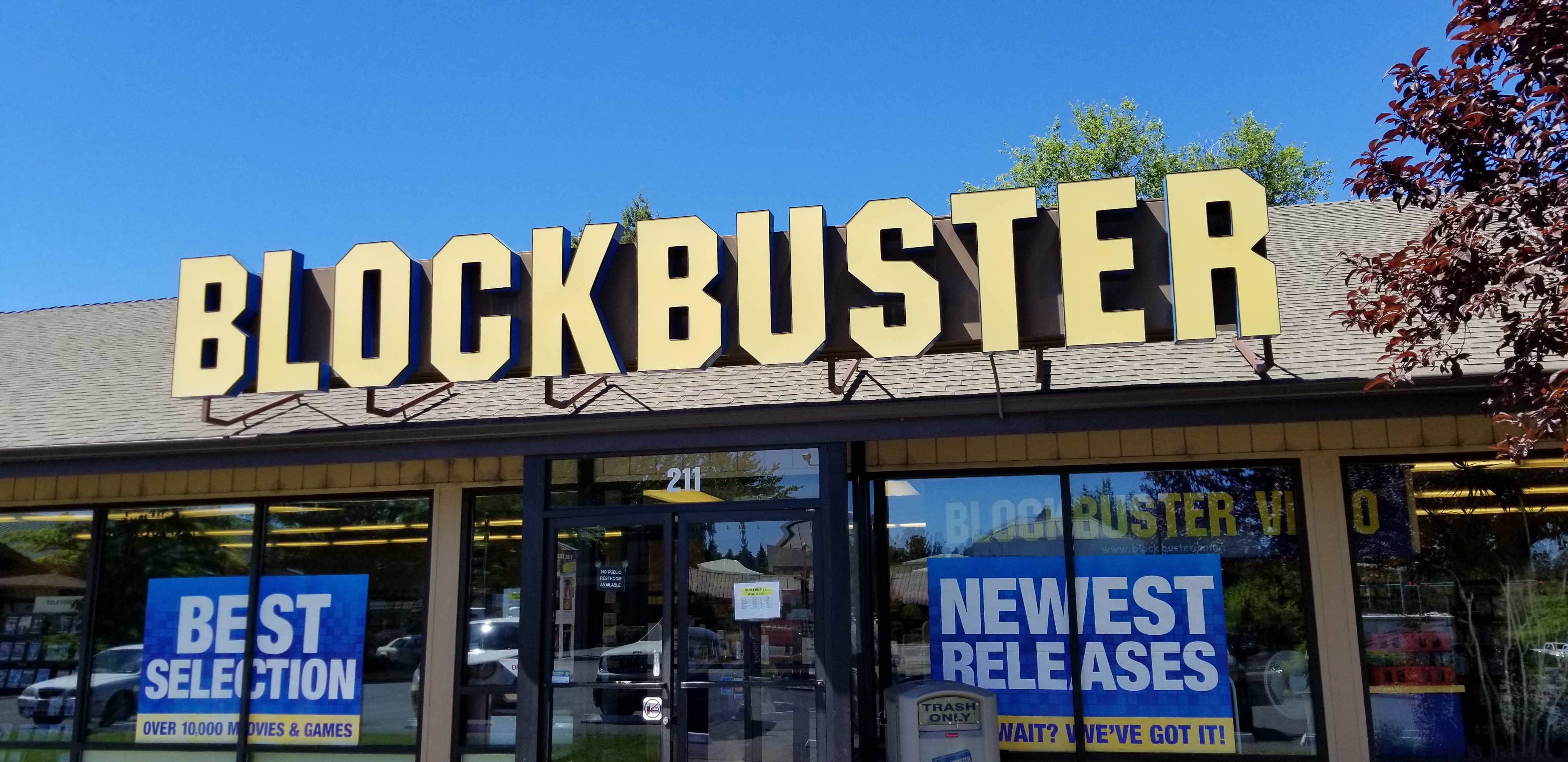 Photo: Wikimedia Commons. CC BY-SA 4.0.
The Meeting in Dallas
The story of the meeting comes primarily from Marc Randolph, Netflix’s co-founder and first CEO, who was in the room. In his 2019 memoir That Will Never Work, Randolph describes the trip to Dallas with Reed Hastings in vivid detail. Netflix was struggling. It had fewer than 300,000 subscribers. It was burning through cash. The dot-com bubble had just burst, and as I covered in my piece on the crash that killed 8,000 companies, every internet company was fighting for survival.
Hastings and Randolph proposed a deal: Blockbuster would acquire Netflix for $50 million. Netflix would become Blockbuster’s online division. Blockbuster’s massive physical presence, roughly 7,700 stores worldwide and tens of millions of registered customers, would be paired with Netflix’s technology and online expertise.
“They just about laughed us out of their office.” – Marc Randolph, That Will Never Work (2019)
Antioco’s reaction was not irrational given the information he had. Netflix was a tiny, unprofitable company selling a niche service at the worst possible moment in the market. The dot-com hysteria had produced hundreds of companies with grandiose promises and no revenue. Many of them were evaporating daily. Why would the king of video rental pay $50 million for a company that mailed DVDs to a few hundred thousand people?
The Logic of Laughter
I think the most instructive part of this story is not that Antioco was wrong. It is that he was right about almost everything except the one thing that mattered.
He was right that Netflix was unprofitable. It was. He was right that the dot-com market was collapsing. It was. He was right that physical retail was still the dominant way Americans consumed movies. In 2000, Blockbuster’s revenue was approximately $4.9 billion. Netflix’s was a rounding error by comparison.
What Antioco missed was the trajectory. He evaluated Netflix as a static snapshot, a small company with small numbers. He did not evaluate it as a curve, a company whose core technology and business model would scale exponentially as broadband internet adoption grew. This is the classic innovator’s dilemma, the term coined by Clayton Christensen in his 1997 book of the same name. Incumbent companies are structurally incapable of valuing disruptive innovations because those innovations initially look inferior to existing products.
DVDs by mail looked inferior to a Blockbuster store. No browsing the aisles. No impulse rentals. No instant gratification. But DVDs by mail had no late fees, which was the single greatest source of customer resentment in the video rental industry. Blockbuster collected an estimated $800 million per year in late fees. That $800 million was not just revenue. It was a signal that the entire business model was built on punishing customers. Netflix bet that customers would choose convenience and fairness over tradition.
What Blockbuster Did Next
To his credit, Antioco was not entirely blind to the threat. By 2004, he launched Blockbuster Online, a DVD-by-mail service designed to compete directly with Netflix. It was actually a solid product, reaching over 2 million subscribers by 2006. The Total Access program, introduced with a big campaign in 2007, then gave Blockbuster something Netflix could not match: subscribers could return their online rentals to a physical store and pick up a new movie on the spot.
At my hosting company, I treated every customer complaint as a personal failure. Blockbuster treated its $800 million in late fees as revenue, not as the warning signal it was. These founders treat complaints as data. That difference in framing changes everything.
But here is where corporate politics killed a company. Carl Icahn, the activist investor who had taken a significant stake in Blockbuster, opposed Antioco’s digital strategy. Icahn believed the company should focus on extracting maximum profit from its existing stores rather than investing in an expensive online pivot. The board sided with Icahn. Antioco was pushed out in 2007 and replaced by Jim Keyes, a former convenience store executive who had no background in digital media.
The man who came closest to saving Blockbuster was ultimately removed by the people who owned it.
Keyes immediately scaled back the online division and refocused the company on its physical stores. By 2010, Blockbuster filed for Chapter 11 bankruptcy. By 2014, the last corporate-owned stores were closed. The lone survivor, the Bend, Oregon store, operates today as a combination rental shop, tourist attraction, and monument to what happens when a company refuses to evolve.
Netflix After the Meeting
What did Netflix do after being laughed out of the room? They survived the dot-com crash, went public in 2002 at $15 per share, and began the slow, disciplined process of building a subscriber base that would eventually top 200 million worldwide.
The key innovation was not the technology. It was the culture. As I wrote about in my piece on the Keeper Test, Hastings built Netflix around the principle of talent density, hiring the best people, paying them the most, and giving them radical freedom. This culture allowed Netflix to make the leap from DVDs to streaming, from licensing content to producing it, and from a domestic service to a global platform.
The year Netflix was born, 1997, was the same year that produced Google, PayPal’s predecessor, and a wave of companies that would define the next two decades. Netflix survived the crash not because it had better funding or better luck, but because it had better people making better decisions under extreme pressure.
The $50 Million That Became $200 Billion
The math of this story is staggering. If Blockbuster had acquired Netflix for $50 million in 2000, it would have owned a company that is now worth over $200 billion. That represents a return of roughly 4,000x. For context, Blockbuster’s entire market capitalization at the time of the meeting was approximately $5 billion. Netflix alone would have made every Blockbuster shareholder spectacularly wealthy.
But acquisition alone would not have been enough. Blockbuster would have needed to nurture Netflix’s culture, invest in its technology, and eventually cannibalize its own store-based business model. History suggests that large companies almost never do this. They acquire innovative companies and then suffocate them with process, bureaucracy, and the gravitational pull of the existing business.
The Blockbuster story is not really about one bad meeting. It is about the structural inability of dominant companies to destroy their own business models in favor of something better. Antioco’s laugh was not stupidity. It was the sound of a man standing at the peak of a mountain, unable to see that the ground was already shifting beneath his feet.
The One Store Left
I find it meaningful that the last Blockbuster store survives not because of business strategy but because of nostalgia. People visit it the way they visit museums. They rent movies they could stream in seconds because they want to remember what it felt like. The store’s continued existence is a tribute to what Blockbuster meant to a generation and a reminder of how quickly meaning can evaporate when a company stops adapting.
Netflix and Blockbuster started from the same insight: people want to watch movies at home. One company built a system that got better every year. The other built a system that stayed the same. The $50 million meeting was not the moment Blockbuster died. It was the moment the diagnosis became clear. The outcome, however, was written long before the meeting and long after it, in thousands of small decisions about whether to evolve or to stay comfortable.
The companies that survive are the ones that treat disruption not as a threat to be dismissed but as a signal to be decoded. That is the lesson of Blockbuster, and it is as relevant today as it was in that conference room in Dallas.
Sources
- Randolph, M. That Will Never Work: The Birth of Netflix and the Amazing Life of an Idea. Little, Brown and Company, 2019.
- Keating, G. Netflixed: The Epic Battle for America’s Eyeballs. Portfolio, 2012.
- Christensen, C. The Innovator’s Dilemma: When New Technologies Cause Great Firms to Fail. Harvard Business Review Press, 1997.
- Satell, G. “A Look Back at Why Blockbuster Really Failed.” Forbes, September 5, 2014.
- Poggi, J. “Blockbuster’s Rise and Fall.” The Street, September 23, 2010.
- Hastings, R. and Meyer, E. No Rules Rules: Netflix and the Culture of Reinvention. Penguin Press, 2020.