
I was cleaning out my bookshelf last Saturday and found an old copy of Business 2.0 magazine from 2000 with a cover story about some startup that no longer exists. I couldn’t even Google the company – it had vanished completely. That got me thinking about how many others disappeared the same way, because the dot-com crash sits in the background of almost every Silicon Valley origin narrative from that era, a massive economic earthquake that swallowed thousands of companies whole and left the survivors permanently changed. But the more I dug into the actual numbers, the more I realized that the crash was not just a catastrophe. It was a filter. And the companies that passed through it went on to define the modern internet.
So what exactly happened? And why did the survivors succeed where 8,000 others failed?
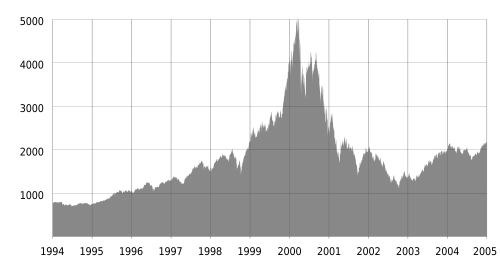 Photo: Wikimedia Commons. Public Domain.
The Bubble
To understand the crash, you have to understand the mania that preceded it. The spark was the Netscape IPO on August 9, 1995. A company that had never turned a profit opened at $28 per share and closed at $58.25. Co-founder Marc Andreessen was 24 and suddenly worth $58 million. The message was unmistakable: the internet was where fortunes would be made.
What followed was a gold rush. Between 1995 and 2000, venture capital poured into any company with a “.com” in its name. Business plans were optional. The theory was simple: get big fast, worry about profits later. Eyeballs over earnings. The NASDAQ climbed from around 1,000 in 1995 to 5,048.62 on March 10, 2000. A five-fold increase in five years.
At the peak of the bubble, more than 370 internet companies were publicly traded, and most had never earned a single dollar of profit.
The Crash
On March 10, 2000, the NASDAQ hit its all-time high. Then it started falling. By October 2002, it had dropped to 1,114, a decline of 78%. More than $5 trillion in market value was erased.
Pets.com folded nine months after its IPO. Webvan burned through $1.2 billion before declaring bankruptcy. An estimated 8,000 dot-com companies either closed or were acquired for pennies between 2000 and 2003. Silicon Valley lost approximately 200,000 jobs. The phrase “internet company” went from badge of honor to punchline.
The Lucky and the Smart
While thousands of companies vanished, a handful not only survived but emerged from the wreckage stronger than ever. The reasons they survived are worth understanding — they are not random.
When I closed my hosting company, I felt relief before I felt sadness. That says a lot about where my head was in those final years.
Zip2: Sold Before the Storm
The Musk brothers got out just in time. In February 1999, Compaq acquired Zip2 for $307 million, a full thirteen months before the NASDAQ peaked and crashed. It was not strategic genius. The Musks had been trying to take Zip2 public, and the acquisition offer simply came first. But the timing was impeccable. Had Zip2 held on another year, the IPO window would have slammed shut. The same company might have ended up on the casualty list instead of the success list.
Elon Musk took his $22 million share and immediately bet it on X.com, pouring $12 million of his own money into an online banking startup. He was launching a financial services company into the teeth of the worst tech downturn in history. The audacity of that move still amazes me.
PayPal: Surviving by Solving a Real Problem
PayPal survived the crash for a specific reason: it was solving a real problem that real people were willing to pay for. eBay sellers needed a way to accept payments online. PayPal provided it. While companies built on advertising revenue saw their income evaporate as ad budgets were slashed, PayPal was processing real transactions for real money.
That is not to say it was easy. As I covered in my article on the PayPal Mafia, PayPal was battling massive fraud, battling internal power struggles, and burning through cash at an alarming rate. The company went public in February 2002, and eBay acquired it for $1.5 billion in October of that same year. PayPal survived the crash not because it was immune to the chaos but because its product was essential.
Netflix: The Painful Pivot
Netflix was hit hard by the crash. The company had been planning an IPO in 2000, and the market collapse forced them to shelve those plans entirely. Revenue was growing but so were losses. In early 2001, Reed Hastings made the agonizing decision to lay off approximately one-third of the company, cutting from 120 employees to about 80.
What happened next became the foundation of the Keeper Test. Hastings noticed something counterintuitive: the remaining 80 employees were doing better work than the original 120 had done. Productivity went up. Morale went up. The quality of output improved across every metric. The layoffs had inadvertently concentrated the talent, and the result was a revelation that would shape Netflix’s entire culture.
Amazon: The Long-Term Bet
Jeff Bezos watched Amazon’s stock price fall from $107 to $7 between late 1999 and late 2001. A 93% decline. The company’s own employees were questioning whether it would survive. Bezos’ response was to keep investing in infrastructure, logistics, and customer experience while his competitors cut spending to the bone.
Bezos later said he knew that if they did the right thing for the customer, the stock price would eventually follow. He was right. Amazon’s focus on long-term fundamentals over short-term stock performance became a case study that business schools still teach. The company that Wall Street had left for dead grew into the most dominant e-commerce platform on the planet.
Google: Born in the Ashes
Google technically launched during the downturn. Larry Page and Sergey Brin incorporated in September 1998 and spent the bubble years quietly building a search engine that actually worked. Google didn’t go public until August 2004, after the wreckage had cleared. By then it had a dominant product, a proven business model, and a culture that owed nothing to hype.
What the Crash Actually Killed
The dot-com crash killed speculation about the internet, not the internet itself. The companies that died had confused growth with value, measuring success in page views rather than revenue. The survivors — Amazon, PayPal, Netflix, Google — had products that solved real problems. They treated the crash as a competitive advantage: while rivals folded, they hired the best talent and built the infrastructure that would power their future dominance.
The dot-com crash is often described as the end of an era. I think it was the beginning of the one we are living in now. The wreckage cleared, the hype drained out, and what was left were the companies that had been building something real all along.
Sources
- Cassidy, J. Dot.con: How America Lost Its Mind and Money in the Internet Era. Harper Perennial, 2003.
- Lowenstein, R. Origins of the Crash: The Great Bubble and Its Undoing. Penguin Books, 2004.
- Vance, A. Elon Musk: Tesla, SpaceX, and the Quest for a Fantastic Future. Ecco, 2015.
- Hastings, R. and Meyer, E. No Rules Rules: Netflix and the Culture of Reinvention. Penguin Press, 2020.
- U.S. Bureau of Labor Statistics. “Employment changes in information technology industries, 2000-2003.”
- NASDAQ Historical Data. nasdaq.com.
- Stone, B. The Everything Store: Jeff Bezos and the Age of Amazon. Little, Brown and Company, 2013.