I have been compiling a mental list of companies that shaped the world without most people ever knowing their names, and Sun Microsystems sits near the top of that list. If you have ever written or used software built in Java, opened a document in LibreOffice, run a virtual machine in VirtualBox, or used MySQL to power a website, you have used something that Sun Microsystems created. If you have ever heard the phrase “the network is the computer,” that was Sun’s motto, coined decades before cloud computing made it literally true.
Sun was not a consumer brand. Most people who benefited from its technology never heard its name. But the engineers and open-source advocates who shaped the modern internet consider Sun one of the most important companies in the history of computing. I wanted to understand why.
Stanford, Berkeley, and a Workstation
Sun Microsystems was founded on February 24, 1982, by four young men who came from two of the best engineering programs in the world. Scott McNealy, Andy Bechtolsheim, and Vinod Khosla were all Stanford University graduate students. Bill Joy came from the University of California, Berkeley, where he had been a key contributor to BSD Unix, one of the foundational operating systems of the internet.
The name SUN itself was an acronym: it stood for Stanford University Network. Bechtolsheim had designed a network workstation called the SUN workstation as part of his graduate work at Stanford. It was a powerful, affordable computer designed to be connected to a network, a radical concept at a time when most computing was done on isolated mainframes or primitive personal computers.
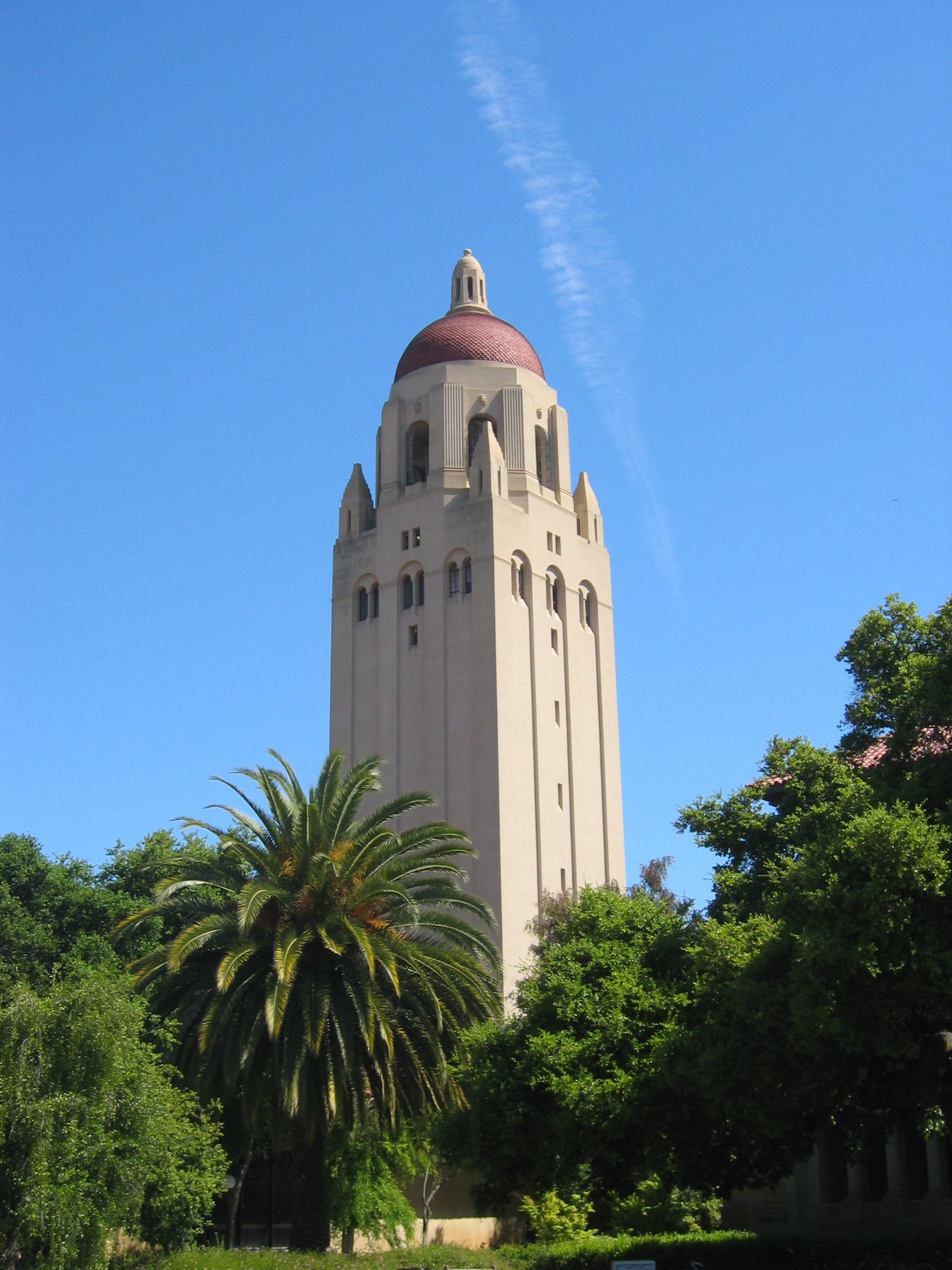 Photo: Wikimedia Commons. CC BY-SA 3.0. Stanford University’s Hoover Tower. The SUN workstation was born here as a graduate project before becoming the foundation of a multi-billion-dollar company.
The first product, the Sun-1 workstation, was built around a Motorola 68000 processor with 1 MB of RAM and ran a version of Unix. It was not a personal computer for home users. It was a professional tool for engineers, scientists, and researchers who needed serious computing power connected to a network. Sun sold these workstations to universities, government agencies, and corporations that were building the early internet infrastructure.
By the mid-1980s, Sun had become one of the fastest-growing companies in Silicon Valley. It went public in 1986 and quickly became the dominant maker of Unix workstations. Its hardware powered a significant portion of the internet’s early backbone, including many of the servers that ran the first websites and email systems.
“The Network Is the Computer”
Sun’s motto, coined by John Gage, was not just a marketing slogan. It was a genuine architectural philosophy that guided the company’s engineering decisions. At a time when most technology companies were focused on making faster individual computers, Sun was building systems designed to work together across networks.
This philosophy manifested in several ways. Sun developed NFS (Network File System), which allowed computers on a network to share files seamlessly, a technology still used today. They created SPARC processors, which powered their high-end workstations and servers. They developed Solaris, a robust Unix-based operating system known for its reliability and scalability.
But the most consequential product to emerge from Sun was not hardware or an operating system. It was a programming language.
Java: Write Once, Run Anywhere
In the early 1990s, a team at Sun led by James Gosling began working on a programming language designed for embedded devices like set-top boxes and appliances. The project, originally called Oak, evolved into something far more ambitious when the team realized that the same language could be used to write programs that ran on any computer, regardless of its hardware or operating system.
At my company, I had a loyal customer base of about 200 people. I knew most of them by name. That felt like success until I realized it also felt like a ceiling — Sun was writing software for every computer on the network, while my own service could never reach past those 200 people in one city.
The language was renamed Java and officially released in 1995. Its defining feature was the Java Virtual Machine (JVM), a layer of software that sat between the Java code and the underlying hardware. A programmer could write a Java application once, and it would run on any machine that had a JVM installed, whether that machine was a Windows PC, a Mac, a Unix workstation, or eventually a mobile phone.
 Photo: Wikimedia Commons. CC BY-SA 4.0. Silicon Valley, where Sun Microsystems operated from its founding in 1982 until Oracle’s acquisition in 2010.
Sun’s slogan for Java was “Write Once, Run Anywhere”, and it captured something powerful. For the first time, developers could write software without worrying about which specific hardware it would run on. This portability made Java enormously popular, and it quickly became one of the most widely used programming languages in the world.
Today, decades after its creation, Java remains one of the top three most used programming languages globally, according to multiple industry surveys. It powers Android apps, enterprise systems, financial trading platforms, and millions of web applications. The JVM concept also inspired other languages and runtimes, including the modern containerization movement that powers cloud computing.
The Open-Source Legacy
What I find most admirable about Sun is its deep commitment to open-source software, a commitment that was unusual and sometimes controversial in the corporate technology world of the 1990s and 2000s.
Sun acquired StarOffice in 1999 and released its code as the open-source project OpenOffice.org, giving the world a free alternative to Microsoft Office. That project eventually evolved into LibreOffice, which is still actively developed and widely used today. Sun acquired VirtualBox — a virtualization tool created by the German company InnoTek — in 2008, and it remains one of the most widely used free tools for running multiple operating systems on a single computer. And Sun acquired MySQL AB in 2008, gaining ownership of MySQL, the open-source database that powers a vast portion of the web.
In 2005, Sun took the remarkable step of open-sourcing Solaris, its flagship operating system, as OpenSolaris. And in 2007, Sun open-sourced Java itself under the GNU General Public License, ensuring that the language would remain freely available to developers forever.
This generosity was not always rewarded by the market. Sun’s stock price declined through the 2000s as its hardware business faced increasing competition from cheaper alternatives running Linux on commodity Intel processors. The dot-com crash hit Sun particularly hard, as many of its biggest customers were internet startups that disappeared overnight.
Bechtolsheim, Google, and the Circle That Closed
There is a detail in Sun’s story that I find particularly satisfying. Andy Bechtolsheim, who had co-founded Sun Microsystems in 1982, became one of the most prolific angel investors in Silicon Valley. In August 1998, he watched a demo of a new search engine created by two Stanford graduate students named Larry Page and Sergey Brin. Bechtolsheim was so impressed that he wrote a check for $100,000 on the spot, made out to a company called “Google Inc.” that did not yet have a bank account. The full story of that investment is one of the great moments in Silicon Valley history.
That one check, written by a Sun co-founder, helped launch the company that would eventually dominate the internet. It is a reminder of how tightly connected the threads of Silicon Valley history really are.
Oracle and the End
By 2009, Sun was struggling financially. Its revenue had declined from a peak of $18.3 billion in 2001 to about $11.4 billion. On April 20, 2009, Oracle Corporation announced that it would acquire Sun Microsystems for approximately $7.4 billion. The deal closed on January 27, 2010, and Sun Microsystems ceased to exist as an independent company.
Oracle’s stewardship of Sun’s technologies has been a mixed bag. Java continues to thrive, but Oracle’s more restrictive licensing approach has generated controversy. MySQL remains widely used, though some developers have migrated to MariaDB, a fork created by MySQL’s original developer in response to concerns about Oracle’s intentions. VirtualBox is still available. OpenSolaris was discontinued.
But I think the most important measure of a technology company is not how it ended but what it left behind. Sun Microsystems left behind Java, one of the most important programming languages ever created. It left behind a philosophical commitment to open source that influenced an entire generation of developers. It left behind the idea that the network is the computer, an idea that was ahead of its time by at least two decades and that now describes the architecture of nearly every significant technology platform in the world.
The PayPal Mafia gets a lot of attention for producing founders who went on to build new companies. But Sun’s legacy is arguably more foundational. It produced not just founders and investors, but the actual tools and infrastructure that those founders used to build the next generation of technology. Every Android app running on a JVM, every website powered by MySQL, every developer using LibreOffice or VirtualBox, they are all using the fruits of what four young engineers from Stanford and Berkeley planted in 1982.
That is a legacy worth celebrating.
Sources
- Hall, Mark, and John Barry. Sunburst: The Ascent of Sun Microsystems. Contemporary Books, 1990.
- Southwick, Karen. High Noon: The Inside Story of Scott McNealy and the Rise of Sun Microsystems. Wiley, 1999.
- Gosling, James, Bill Joy, Guy Steele, and Gilad Bracha. The Java Language Specification. Addison-Wesley, various editions.
- “Oracle Completes Acquisition of Sun Microsystems.” Oracle Press Release, January 27, 2010.
- “TIOBE Index for Programming Language Popularity.” tiobe.com.
- Bechtolsheim, Andy. Interview references in Battelle, John. The Search. Portfolio, 2005.