I was tracing the origin stories of the companies that survived the dot-com crash when I noticed something that connects nearly all of them: the founders did not start with a brilliant technology or a revolutionary insight. They started with a decision. A moment where they chose to leave something safe and step into something unknown. No one embodies that pattern more clearly than Jeff Bezos, who in 1994 quit the most comfortable job in American finance and drove across the country to sell books from a garage.
What makes someone walk away from a guaranteed fortune to chase something that has never been done before?
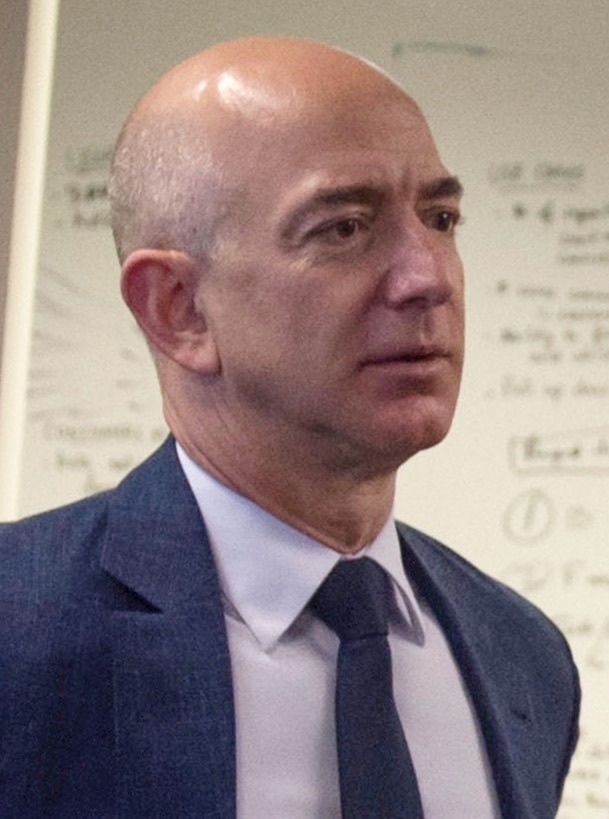 Photo by Adrian Cadiz / U.S. DoD, Wikimedia Commons. License: CC BY 2.0.
D.E. Shaw and the Comfortable Life
Before Amazon, Bezos worked at D.E. Shaw & Co., a quantitative hedge fund on Wall Street. He was not a junior analyst. By 1994, at the age of thirty, he had risen to become the firm’s youngest-ever senior vice president. D.E. Shaw was one of the most prestigious and profitable firms in finance, and Bezos was on track for a career that would have made him very wealthy without ever needing to take the kind of risk he was about to take.
The internet changed his calculation. In early 1994, Bezos came across a statistic that he has cited many times: web usage was growing at approximately 2,300% per year. That number stopped him cold. He understood, with the precision of someone trained in quantitative analysis, that a growth curve of that magnitude represented an opportunity that would not last. The window for building something foundational on the internet was open, and it would not stay open forever.
He told his boss, David Shaw, about his plan. Shaw, to his credit, took Bezos on a long walk through Central Park to discuss it. He told Bezos that the idea sounded like a good one, but that it was a better idea for someone who did not already have a great job. For someone already on track to become spectacularly successful in finance, leaving was irrational.
“He convinced me to think about it for 48 hours before making a final decision.” – Jeff Bezos, Princeton commencement address, 2010
The Regret Minimization Framework
Bezos went home and thought about it. The tool he used to make the decision has since become one of the most quoted frameworks in startup culture: the regret minimization framework. He projected himself forward to age eighty and asked a simple question: “Will I regret not trying this?”
“I knew that when I was 80, I was not going to regret having tried this. I was not going to regret trying to participate in this thing called the Internet that I thought was going to be a really big deal. I knew that if I failed, I wouldn’t regret that. But I knew the one thing I might regret is not ever having tried.” – Jeff Bezos, interview, 1999
The answer was obvious. He would regret missing the beginning of the internet far more than he would regret failing at a startup. He gave his notice at D.E. Shaw, and he and his wife, MacKenzie, began packing.
This framework is deceptively simple, but I think its power comes from what it eliminates. It removes short-term risk from the equation entirely. It does not ask “what if I lose money?” or “what if it fails?” It asks only: “will I wish I had tried?” For Bezos, the answer was yes, and that made every other consideration secondary.
The Drive West
In the summer of 1994, the Bezoses loaded up their car and drove from New York City to Seattle. The choice of Seattle was strategic: it was close to one of the largest book distribution warehouses in the country, operated by Ingram Book Group in Roseburg, Oregon. It also had a strong pool of technical talent and, crucially, a smaller population than California or New York, which meant lower sales tax obligations under the interstate commerce rules of the time.
I closed my company after ten years with almost exactly the same revenue I had in year three. Bezos drove west to escape exactly that kind of stability. Stability like that is not a business strategy. It is a slow goodbye.
When I read about Bezos walking away from a guaranteed fortune at D.E. Shaw, I try to imagine making a bet that size with my own future. I cannot. And that tells me something about myself that I am still processing.
During the drive, MacKenzie drove while Jeff sat in the passenger seat, typing the business plan for his new company on a laptop. He made financial projections and called potential investors from his cell phone. The business plan was written in transit, on a highway between two lives, one defined by financial security and the other by uncertainty.
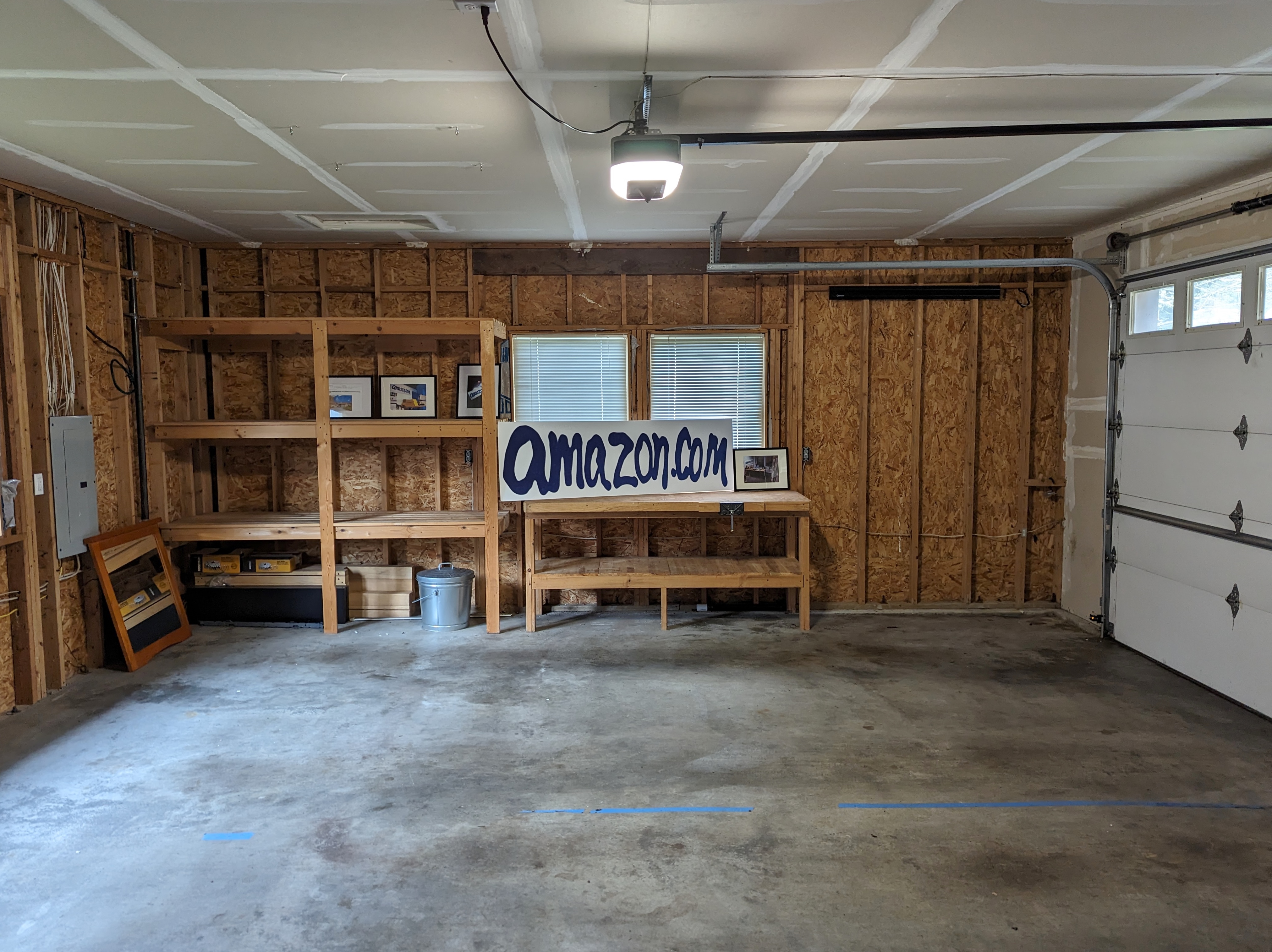
They arrived in Bellevue, Washington, a suburb of Seattle, and set up shop in the garage of their rented home. The image of the garage startup is so embedded in Silicon Valley mythology that it risks becoming a cliche, Apple started in a garage, HP started in a garage, Google started in a garage. But for Bezos, the garage was not a stylistic choice. It was the cheapest option available.
Door Desks and Day One
The garage in Bellevue became Amazon’s first office. Bezos built desks from solid-core doors purchased at Home Depot, mounted on two-by-four legs. These “door desks” were not a quirky aesthetic decision. They were a statement about frugality that Bezos would embed into Amazon’s culture for decades. Even after Amazon became one of the most valuable companies in the world, door desks remained a symbol of the company’s founding principle: spend money on things that matter to customers, not on things that impress visitors.
Bezos initially considered several names for the company, including Cadabra (as in “abracadabra”), which his lawyer misheard as “cadaver” during a phone call. He settled on Amazon, after the world’s largest river, because he wanted the company’s name to suggest scale and breadth.
The first product category was books, not because Bezos was passionate about literature but because books were the perfect commodity for online retail. There were more than 3 million books in print at any given time, far more than any physical bookstore could stock. A physical Barnes & Noble or Borders store might carry 100,000 to 200,000 titles. An online bookstore could theoretically carry all of them. The internet’s advantage was not price or convenience. It was selection.
Amazon shipped its first book in July 1995. Within the first month, the company had shipped orders to all fifty states and to forty-five countries. The internet was not local. It was everywhere.
The Barnes & Noble Irony
There is a detail from Amazon’s early days that I find particularly revealing. In the early months, Bezos and his small team did not have a break room or a meeting space in their garage office. When they needed to have a longer conversation or brainstorm, they would walk to the nearest Barnes & Noble and hold their meetings there, surrounded by the very product they were trying to sell.
Bezos was sitting in his competitor’s store, planning the company that would eventually devastate the physical bookstore industry. Barnes & Noble’s management likely had no idea that the man sipping coffee in their reading area was building the machine that would force hundreds of their locations to close.
This pattern of incumbents unknowingly hosting their disruptors echoes the Blockbuster-Netflix dynamic that would play out a few years later. The dominant players were so confident in their position that they could not imagine the threat was already in the room.
The IPO and the Beginning
Amazon went public on May 15, 1997, at $18 per share. The year 1997 was remarkable for the number of foundational tech companies that launched or went public that year. Netflix was founded. Google’s research began at Stanford. PayPal’s predecessor was taking shape. The internet economy was accelerating, fueled by the momentum that the Netscape IPO had generated two years earlier.
At its IPO price of $18, Amazon’s market capitalization was approximately $438 million. Wall Street was skeptical. Many analysts argued that Amazon was overvalued, that an online bookstore could never compete with the physical retail chains that dominated the market. The famous Barron’s cover from 1999, “Amazon.bomb,” captured the establishment’s contempt for Bezos’ vision.
Those analysts were not wrong about the challenges. Amazon did not turn a profit until 2001, and even then, the profit was modest. But they fundamentally misunderstood what Amazon was building. It was not building a bookstore. It was building the infrastructure for all of online commerce, a platform that would eventually sell everything from books to cloud computing to groceries.
The Road Trip as a Pattern
What strikes me most about the Bezos origin story is how closely it mirrors other founder journeys from the same era. The Musk brothers drove across North America looking for opportunity before landing on Zip2. Reed Hastings and Marc Randolph brainstormed Netflix during their carpool commute. There is something about physical movement, the act of leaving one place for another, that seems to accompany the mental leap of starting a company.
Bezos did not just change jobs. He changed geography, identity, and risk profile in a single cross-country drive. He went from a senior VP at a hedge fund to a man building desks out of doors in a garage. The distance between those two realities is measured not in miles but in the willingness to look foolish.
The regret minimization framework gave him permission to do that. And what he built from that garage, a company that would eventually employ over 1.5 million people and reshape the way humanity buys, reads, watches, and computes, started with a simple drive west and a question only he could answer: “Will I regret not trying?”
He would not. And that made all the difference.
Sources
- Stone, B. The Everything Store: Jeff Bezos and the Age of Amazon. Little, Brown and Company, 2013.
- Bezos, J. “We Are What We Choose.” Princeton University Commencement Address, May 30, 2010.
- Bezos, J. “Regret Minimization Framework.” Interview, 1999. YouTube.
- Brandt, R. One Click: Jeff Bezos and the Rise of Amazon.com. Portfolio, 2011.
- Levy, S. “Jeff Bezos Owns the Web in More Ways Than You Think.” Wired, November 13, 2011.
- Amazon Annual Reports and SEC Filings, 1997-2001.