

I was researching the Netscape IPO when I realized that most people know the financial story — the stock that doubled on day one, the billions in market cap — but almost nobody talks about the person who actually built the thing. Marc Andreessen was 22 years old when he co-created Mosaic, the web browser that made the internet usable for ordinary people. A year later, he co-founded Netscape and kicked off the entire internet economy. And he did it all before he could legally rent a car without paying a surcharge.
What was it about a kid from a small town in Wisconsin that let him see the future of the internet before anyone else?
Did you know? When the Netscape IPO made Andreessen a fortune at 24 in August 1995, Elon Musk was also 24 — busy founding Zip2. Two 24-year-olds opened the commercial internet in the same year.
The Basement in Illinois
Andreessen grew up in New Lisbon, Wisconsin, a town of about 1,500 people. He taught himself to program in elementary school by reading library books about BASIC. After high school, he enrolled at the University of Illinois at Urbana-Champaign, where he studied computer science. During his studies, he took a part-time job at the university’s National Center for Supercomputing Applications (NCSA), earning $6.85 an hour.
At NCSA, Andreessen met Eric Bina, a full-time programmer who was older, more experienced, and less interested in publicity. The two of them shared a frustration: the World Wide Web existed, but using it was terrible. In 1993, browsing the web required command-line tools like Lynx, which displayed nothing but text. There were no images, no clickable links, no visual design. The web had content but no interface.
Andreessen and Bina decided to fix this. Working through the winter of 1992-1993, often in marathon coding sessions that lasted until dawn, they built Mosaic — a graphical web browser that could display images alongside text, render clickable hyperlinks, and run on both Unix and Windows machines.
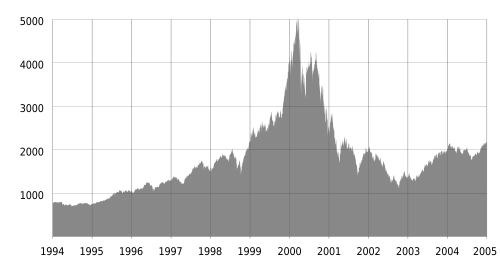 Photo: The NASDAQ display during the dot-com era that Andreessen’s Netscape helped ignite. Wikimedia Commons. License: CC BY-SA 3.0.
Mosaic was released in early 1993 and spread through the internet like wildfire. Within months, it had millions of downloads. For the first time, non-technical people could point, click, and browse the web — and it was the first browser that made the web feel like a place you would want to spend time. Mosaic did not create the internet, but it created the experience of the internet — the visual, interactive, intuitive experience that we now take for granted.
The Phone Call That Changed Everything
After graduating in December 1993, Andreessen moved to California and took a job at a small company called Enterprise Integration Technologies. He was bored. He had built the most important piece of software in the world and was now writing code that nobody would ever use.
Then came the phone call.
Jim Clark, the founder of Silicon Graphics, had been pushed out of his own company by the board of directors. Silicon Graphics had made the computers that rendered the dinosaurs in Jurassic Park and the liquid-metal effects in Terminator 2. Clark was wealthy, restless, and looking for his next venture. He had seen Mosaic and recognized its potential immediately.
In early 1994, Clark cold-emailed Andreessen. They met at a coffee shop in Palo Alto. Clark’s pitch was simple: “Let’s do a Mosaic killer.”
The idea was audacious. Andreessen had built Mosaic at NCSA, which meant the university owned the intellectual property. They could not simply take Mosaic and commercialize it. They would have to build a new browser from scratch — one that was faster, more stable, and more feature-rich than anything that existed.
Recruiting the Team
In April 1994, Clark flew to Illinois and helped Andreessen recruit the best engineers from the NCSA team. They offered salaries, stock options, and the chance to build something that would change the world. Most of them said yes. The exodus was so thorough that NCSA was left scrambling to maintain Mosaic with a skeleton crew.
I did not know the phrase talent density when I ran my company. But I know now that my team’s talent density was low — not because they were bad, but because I hired for affordability instead of excellence. You get what you optimize for.
The new company was initially called Mosaic Communications Corporation, but the University of Illinois threatened legal action over the name. They renamed it Netscape Communications. The browser would be called Netscape Navigator.
 Photo: Peter Thiel at a 2014 event — one of many tech leaders whose career path was shaped by the browser revolution Andreessen started. Wikimedia Commons. License: CC BY 2.0.
The team worked at a ferocious pace. Andreessen was not just the visionary — he was in the code, debugging, reviewing, and pushing the team to ship faster. Netscape Navigator 1.0 launched in December 1994. It was faster than Mosaic, more reliable, and could handle the growing complexity of web pages. Netscape gave the browser away for free to individuals and charged businesses for licenses — a strategy that would later be called “freemium.”
The IPO That Launched an Era
On August 9, 1995, Netscape went public. The company was sixteen months old. It had revenue but no profit. The stock was initially priced at $14 per share, then raised to $28 before the market opened. It opened at $71 and closed the day at $58.25, giving Netscape a market capitalization of $2.9 billion.
Andreessen, at 24, was on the cover of Time magazine, barefoot in a golden chair. He became the face of the internet boom. The Netscape IPO is widely credited with launching the dot-com era — the period of explosive investment and entrepreneurship that would define the late 1990s and transform the global economy.
What happened when that bubble eventually burst is a story I explored in depth when writing about the dot-com crash. But Netscape’s legacy extends far beyond its stock price. The browser wars with Microsoft, the rise of open-source software through Mozilla, and the eventual creation of Firefox and Chrome — all of it traces back to Andreessen and Bina’s coding sessions in an Illinois basement.
From Builder to Backer
After Netscape was acquired by AOL — a deal announced in late 1998 and completed in 1999 — Andreessen moved to the other side of the table. He co-founded Andreessen Horowitz (a16z) in 2009, which became one of the most influential venture capital firms in Silicon Valley. His investments include Facebook, Twitter, Airbnb, GitHub, Coinbase, and dozens of others.
Andreessen’s famous essay “Why Software Is Eating the World,” published in the Wall Street Journal in 2011, argued that every industry would eventually be transformed by software companies. It is one of the most-cited pieces of writing in technology.
The Kid Who Saw It First
Marc Andreessen was not the only person working on web browsers in 1993. But he was the one who understood that the browser was not just a tool for viewing web pages — it was the operating system of the internet. Every application, every service, every business that runs in a browser today exists because a 22-year-old in Illinois saw that future first.
The lesson Andreessen’s story teaches is one that echoes through every generation of technology: the person who builds the interface controls the experience. Whoever makes technology accessible to ordinary people — not just to engineers — wins. Andreessen did that with Mosaic, and the ripples are still spreading.
Sources
- Jim Clark with Owen Edwards, Netscape Time: The Making of the Billion-Dollar Start-Up That Took On Microsoft, St. Martin’s Press, 1999.
- Michael Lewis, The New New Thing: A Silicon Valley Story, W.W. Norton, 1999.
- Tim Berners-Lee, Weaving the Web, HarperBusiness, 1999.
- Marc Andreessen, “Why Software Is Eating the World,” Wall Street Journal, August 20, 2011.
- “The Golden Geeks,” Time magazine cover story, February 19, 1996.



.jpg)