
I was going through a list of technologies that we take for granted today, trying to trace each one back to its origin, when I landed on something that surprised me. Instant messaging, the ability to send a text message to someone and have them receive it immediately, did not come from a Silicon Valley giant or a well-funded research lab. It came from four young Israelis in Tel Aviv who were barely out of the military and had no venture capital backing. Their program was called ICQ, a phonetic play on “I Seek You”, and it changed the way human beings communicate.
ICQ launched in November 1996 and was shut down in June 2024, almost exactly 28 years later. In between, it invented an entire category of software and proved that real-time communication over the internet was not a novelty. It was the future.
Four Founders in Tel Aviv
The company behind ICQ was called Mirabilis, a Latin word meaning “wonderful” or “remarkable.” It was founded in June 1996 by Arik Vardi, Yair Goldfinger, Sefi Visiger, and Amnon Amir, and financed by Arik’s father, the investor Yossi Vardi. They were young, most of them in their twenties, and they built the product while working out of a small office near Tel Aviv.
The problem they wanted to solve was straightforward. In 1996, the internet was primarily a one-way medium. You could visit websites, send emails, and post on forums, but there was no simple way to know when your friends were online or to have a real-time conversation with them. Email had a delay. Chat rooms were impersonal and chaotic. What was missing was a tool that combined the immediacy of a phone call with the convenience of text.
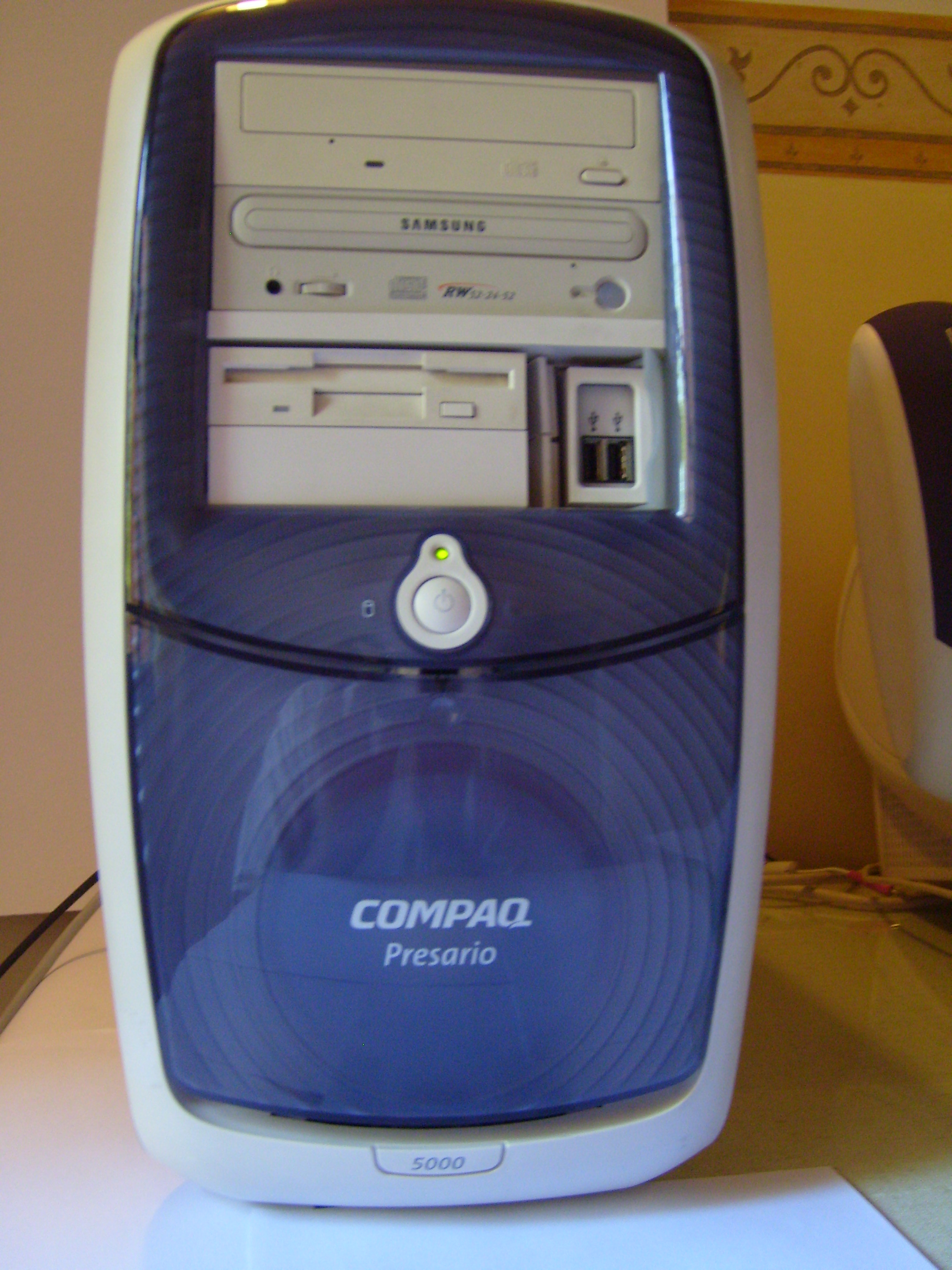 Photo: Wikimedia Commons. CC BY-SA 3.0. A Compaq desktop computer. In the late 1990s, PCs like this were the gateway to ICQ and the new world of instant messaging.
ICQ’s solution was elegant. When you installed the program, you received a unique UIN (User Identification Number). You could add other users to a contact list, and the program would show you which of your contacts were currently online. You could then send them a message, and it would appear on their screen instantly. This sounds trivially simple now, but in 1996, it was revolutionary.
The “Uh-Oh” Heard Around the World
ICQ launched its first public version in November 1996, and its growth was staggering. The program was free to download, and it spread almost entirely through word of mouth. By the end of 1997, ICQ had one million registered users. By 2001, it had passed 100 million accounts.
The experience of using ICQ was distinctive and, for anyone who remembers it, deeply nostalgic. The program made a signature “uh-oh” sound when a new message arrived, a sound that became as recognizable in the late 1990s as a ringing telephone. Users could set their status to “online,” “away,” “do not disturb,” or “invisible,” a feature that every messaging app from AIM to WhatsApp would eventually copy. The contact list, which ICQ pioneered, became the standard interface for every instant messaging client that followed.
What made ICQ’s growth even more remarkable was the context. In the mid-1990s, the Israeli tech scene was still relatively small. Israel had a strong culture of military-trained engineers and a growing number of startups, but it had nothing like the venture capital infrastructure or the media attention that surrounded Silicon Valley at the time. Mirabilis built ICQ without significant outside funding, relying on the quality of the product and the power of viral adoption.
AOL Comes Calling
By 1998, ICQ was growing so fast that it could not be ignored. America Online (AOL), the largest internet service provider in the United States, recognized that instant messaging was going to be a critical feature of the internet experience. AOL had its own instant messaging product, AIM (AOL Instant Messenger), but ICQ had the user base and the momentum.
I grew up during the siege of Sarajevo. I know what real adversity looks like. And yet I could not bring myself to take the small business risks that these founders treated as routine. Fear scales differently when the stakes are money instead of survival.
On June 8, 1998, AOL announced the acquisition of Mirabilis for $287 million in cash, with an additional $120 million in performance-based bonuses, bringing the total deal to potentially $407 million. It was one of the largest acquisitions in the internet industry at the time and one of the biggest exits for an Israeli startup.
 Photo: Wikimedia Commons. Public Domain. The NASDAQ Composite during the dot-com bubble. ICQ’s acquisition by AOL in 1998 was one of the landmark deals of this era.
The acquisition made sense strategically. AOL wanted to dominate real-time communication on the internet, and ICQ gave them a massive international user base that complemented AIM’s primarily American audience. But as is often the case with large corporate acquisitions, the integration was rocky. ICQ continued to operate as a separate product, but it received inconsistent investment and attention from its new parent company.
The Legacy That Lives in Every Chat Window
After the AOL acquisition, ICQ’s story became one of gradual decline. AOL was acquired by Time Warner in the disastrous $164 billion merger of 2000, and ICQ became a small piece of an enormous, dysfunctional conglomerate. In 2010, AOL sold ICQ to the Russian investment firm Digital Sky Technologies (DST Global) for approximately $187.5 million, less than half of what it had originally paid. ICQ continued to operate with a loyal user base, particularly in Russia and Eastern Europe, but it never recaptured its late-1990s dominance.
On June 26, 2024, ICQ was officially shut down after 28 years of operation. Its farewell message directed users to VK Messenger, a Russian social media platform.
But I think it would be a mistake to view ICQ’s story as one of decline. The features that ICQ pioneered, the contact list, the presence indicator, the real-time text message, the status update, are now so deeply embedded in our digital lives that we barely notice them. Every time you check whether a friend is “online” on WhatsApp, or set your Slack status to “away,” or send a message that arrives with a notification sound, you are using something that ICQ invented.
AIM, MSN Messenger, Google Talk, WhatsApp, Telegram, Signal – all of them are descendants of the idea that four young Israelis had in 1996. The internet revolution of the late 1990s produced many products and companies that did not survive. But the best of those products, the ones that genuinely solved a human problem, left behind ideas that outlived the companies themselves.
ICQ proved that real-time communication over the internet was not an experiment. It was a fundamental shift in how people connect. The program is gone, but the idea is everywhere. And I find it inspiring that it all started with four young engineers in Tel Aviv who looked at the internet and asked a simple question: what if you could know when your friends were online, and talk to them right now? That question, and the elegant answer they built, shaped the digital world we live in today. Every chat window on every screen is, in some small way, a descendant of ICQ. And that is a legacy worth remembering.
Sources
- Rosen, Gideon. “ICQ: The Rise and Fall of the App That Changed the Internet.” Haaretz, June 2024.
- “AOL Buys Israeli Firm Mirabilis for $287 Million.” Reuters, June 8, 1998.
- Senor, Dan, and Saul Singer. Start-up Nation: The Story of Israel’s Economic Miracle. Twelve, 2009.
- “ICQ Shutting Down After Nearly 28 Years.” The Verge, June 2024.
- “DST Global Acquires ICQ from AOL.” TechCrunch, April 2010.
- icq.com (archived via Wayback Machine).