A colleague asked me last week what Elon Musk actually built before PayPal. I said “Zip2 — it was like an online yellow pages with maps.” He said “okay, but what did it look like?” And I realized I had no idea. Everyone calls it his “first company” but nobody ever shows you the product. What did users see when they loaded the page in a 1996 web browser? I went digging through the Wayback Machine and found a story about a product that kept reinventing itself every twelve months.
“At Zip2, I wrote entire V1 of software for drawing vector maps & calculating point to point directions anywhere in US (first ever company to do so), as well as white pages & business listings w reviews (an early Yelp).” — Elon Musk
That quote hit me hard. We think of Google Maps as something that always existed. But in 1995, nobody had done this before. Musk didn’t just build a business — he built an entirely new category of software.
 Photo: Steve Jurvetson, Wikimedia Commons. CC BY 2.0.
What Was Zip2?
Zip2 was Elon Musk’s first company: a web platform that put business directories and maps online for newspapers. Founded in 1995, it was acquired by Compaq for $307 million in February 1999, giving Musk the capital he used to start X.com.
The First Version: An Internet Yellow Pages
When Musk founded Zip2 with his brother Kimbal and Greg Kouri in 1995, the concept was deceptively simple. Take the yellow pages, put them online, and add a map.
To pull it off, Musk acquired a disc containing a business directory database. Then he persuaded Navteq, a provider of electronic navigable maps, to give him free mapping software. He wrote the code that merged the two databases — business listings and maps — into a single searchable interface.
The result was the first company in the world to offer point-to-point directions on the internet. Before MapQuest. Before Google Maps. Before any of it.
As I covered in the road trip story, the brothers had seen firsthand that businesses had no idea how to get online. Zip2 was the answer.
1996: Yellow Pages Goes Digital
By 1996, Zip2 was pulling data from American Business Information Inc. (ABI) and leaning hard into a comparison with traditional yellow pages. The brand itself embraced this — at one point using the name “Zip2 Yellow Pages” on its site.
The early interface was basic by today’s standards but revolutionary for its time. You could search for a business, see it on a map, and get directions to it — all in a web browser. In 1996, most people were still using dial-up modems.
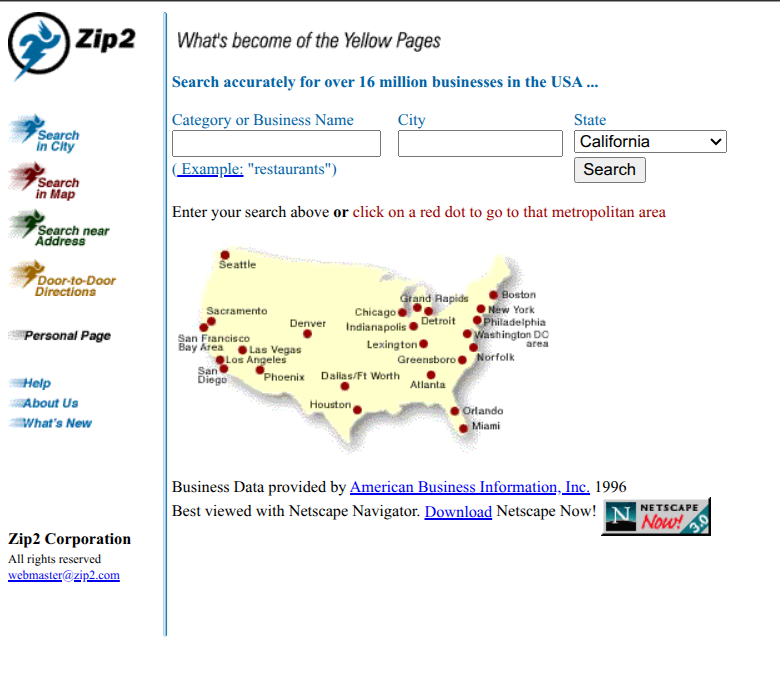 Screenshot: zip2.com, 1996. Captured via the Wayback Machine (archive.org).
Musk famously tried to pitch the head of the actual Yellow Pages on the concept. The response was memorable.
Musk later recalled that the Yellow Pages executive “threw the book at me” — literally tossed a physical yellow pages directory across the table. The message was clear: the internet wasn’t real competition.
That executive was wrong. But in 1996, it was a reasonable position. The internet had only begun its commercial explosion the year before.
1997: The Newspaper Pivot
The most interesting transformation happened in 1997. Zip2 pivoted from being a business directory to becoming a city guide platform for newspapers. This was the move that saved the company.
At my company, I charged in euros and spent in Bosnian marks, and the currency math was always in my favor. And yet I still could not make the business scale the way Zip2 did the moment it stopped pitching skeptics and started selling to newspapers. Money was not the constraint. Imagination was.
Instead of selling directly to small businesses — who were skeptical of the internet — Zip2 started selling to newspapers that wanted to bring their classified sections and city guides online. This was a much easier sale. Newspapers understood content distribution, and they needed technology partners.
The New York Times, Knight-Ridder, and Hearst all became Zip2 customers and eventually investors. As Musk described it:
“Zip2 also built a newspaper publishing platform that brought hundreds of regional & city papers online for the first time and made major functionality advancements to the NY Times, Boston Globe & Knight-Ridder websites. NYT, KR & Hearst were all major investors in Zip2.”
This was a pivotal moment. Zip2 went from a struggling startup that could barely afford a second computer to a company with major media investors.
1998: The eCommerce Turn
In December 1998, Zip2 reinvented itself again. The website shifted focus from newspapers to eCommerce and advertisers. Newspapers lost their prominent display on the homepage. Businesses and online commerce took center stage.
One innovation from this era sounds almost comical now: Zip2 let customers and advertisers communicate via fax. In 1998, that was cutting edge. Email wasn’t universal. Fax was still how businesses communicated.
This was also the period when CEO Rich Sorkin tried to merge Zip2 with CitySearch — a move that Musk famously blocked by organizing a boardroom revolt, as I covered in the Zip2 survival story.
February 1999: The Exit
On February 17, 1999, Compaq Computer Corporation acquired Zip2 for approximately $307 million. Compaq wanted it to power their AltaVista web portal — one of the leading search engines of the era. As I explored in the Compaq story, the company that bought Zip2 wouldn’t survive the decade itself.
Musk walked away with $22 million for his 7% stake. He was 27 years old.
What Zip2 Teaches Us
The thing that struck me most about researching Zip2’s evolution is how many times the product changed direction. It went from yellow pages clone to mapping pioneer to newspaper platform to eCommerce hub — all in four years.
Musk didn’t succeed because his first idea was perfect. He succeeded because he kept adapting. The V1 he coded alone at night was nothing like the V4 that Compaq acquired. Each version was a response to what the market was actually telling him.
That willingness to listen, pivot, and rebuild is what separates founders who survive from those who don’t. And it’s the same instinct that would carry Musk through X.com, SpaceX, and Tesla — companies that each had their own near-death moments before finding their footing.
The first version is never the final version. That’s not failure. That’s how building works.
Sources
- Britannica Money: Zip2 History, Mission, Elon Musk & Facts
- Zip2 Wikipedia
- Locarie: Zip2 — The First Online City Map
- Loop: What Elon Musk’s First Website Looked Like
- CNBC: Elon Musk pitched the head of the Yellow Pages
- AdviceScout: Zip2 — Elon Musk’s First Major Venture
- Ashlee Vance, Elon Musk: Tesla, SpaceX, and the Quest for a Fantastic Future, Ecco, 2015 (Chapter 4: Elon’s First Start-Up)
- Eric Jorgenson, The Book of Elon, 2021
- Franziska M. Renz and Julian U. N. Vogel, “Elon Musk: Leader or Liability?”, Journal of Case Research and Inquiry, Vol. 6, 2020