

I have been fascinated by immigrant founders for a while now. I wrote about Elon Musk leaving South Africa at 17 with $2,000 and a suitcase of books, and about how that journey eventually led him to bet everything on online banking. But there is another immigrant founder story from the same era that I find equally remarkable, and it starts with even less money. Max Levchin arrived in Chicago in 1991 as a Jewish refugee from Soviet Ukraine. He was sixteen years old. His family had $700 to their name. Within seven years, he would co-found the company that became PayPal.
How does a teenage refugee with $700 become the technical architect of one of the most important fintech companies ever built? The answer involves cryptography, a chance meeting at Stanford, and the stubbornness to start six companies before one of them finally worked.
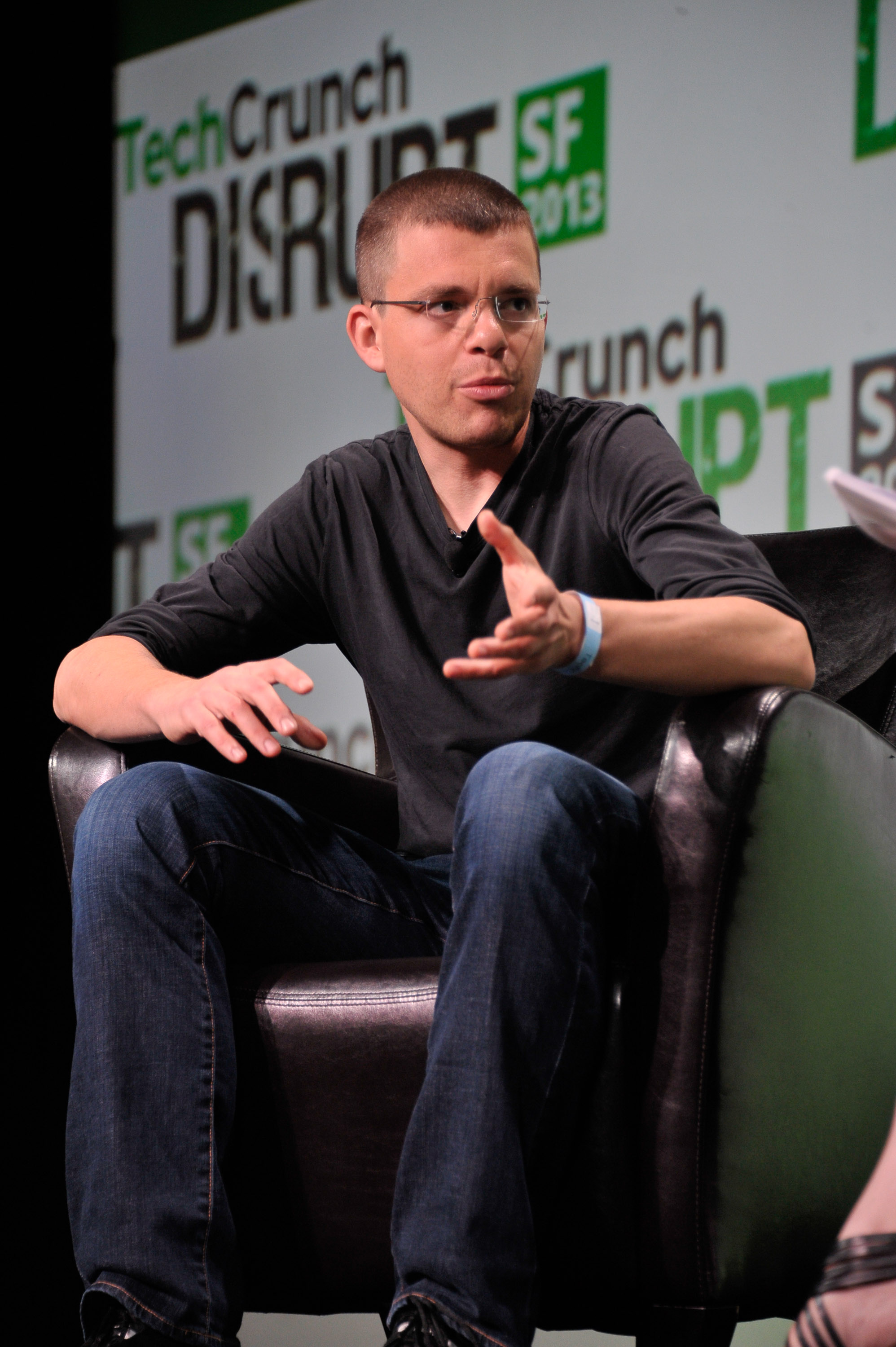 Photo by Steve Jennings / TechCrunch, Wikimedia Commons. License: CC BY 2.0.
Did you know? The people behind this site’s biggest stories were almost all immigrants: Khosla (India), Levchin (Ukraine), Musk and Botha (South Africa), Brin (USSR), Yang (Taiwan), Omidyar (France), Bhatia (India). PayPal and Google were built by the children of immigrants.
From Kiev to Chicago
Max Levchin was born in Kiev, Ukraine, in 1975, into a Jewish family that faced the institutional antisemitism of the Soviet system. His mother was a physicist. His grandmother was a mathematician. The family decided to leave the Soviet Union and applied for refugee status, eventually emigrating to the United States when Max was sixteen.
They settled in Chicago with almost nothing. Levchin has spoken about those early years with the kind of matter-of-fact clarity that comes from having lived through genuine hardship. There was no safety net, no family connections in America, no inherited wealth. What the family had was education and work ethic.
“We came with $700. My mom got a job in a physics lab. I got into the University of Illinois.” – Max Levchin, in interviews about his early life
Levchin enrolled at the University of Illinois at Urbana-Champaign, where he studied computer science and developed what would become a lifelong obsession with cryptography and security. He was not just a good student. He was the kind of programmer who built things compulsively, staying up all night to write code for problems nobody had asked him to solve. By the time he graduated, he had already attempted to start multiple companies, none of which succeeded.
Six Failures Before Confinity
This is the part of the story that most people skip, but I think it is the most important part. Before co-founding Confinity, the company that became PayPal, Levchin had started and failed at five previous ventures. Five. Each one taught him something about building products, about what users actually want versus what engineers think they should want, and about the difference between a clever technology and a viable business.
The failures ranged from security software to database tools. None gained traction. None attracted significant funding. For most people, five consecutive failures would be enough to reconsider the entire path. For Levchin, each failure narrowed the search. He was not failing randomly. He was converging on the intersection of cryptography, mobile computing, and finance that would eventually define his career.
What kept him going? I think part of it was the immigrant mindset. When you have already left everything behind once, the cost of starting over feels smaller. The baseline is $700 and a new country. Everything else is upside.
The Stanford Lecture That Changed Everything
In the summer of 1998, Levchin attended a lecture at Stanford University given by Peter Thiel, a Stanford law graduate and former derivatives trader who was speaking about currency trading and global finance. Levchin was not a Stanford student. He was just a young programmer in the Bay Area who showed up because the topic interested him.
Running a hosting company taught me that technical competence is the price of entry, not the key to success. Levchin could out-code almost anyone in the room, but so could plenty of programmers who never built anything. What separated him was everything else — the meeting with Thiel, the conviction, the timing.
After the lecture, Levchin approached Thiel. The two could hardly have been more different on the surface. Thiel was a Stanford-educated lawyer and philosopher with a libertarian worldview and a background in finance. Levchin was a Ukrainian immigrant and self-taught cryptographer who spoke in code more fluently than in conversation. But they shared a conviction that digital money was going to be important, and that security was the key to making it work.
Their conversations over the following months led to the founding of Confinity in December 1998, initially under the name Fieldlink. Thiel put in the initial $100,000. Levchin became CTO and built the technical infrastructure. The original product, as I explored in my piece on how PayPal started as a way to beam money between Palm Pilots, was a PalmPilot payment application that used infrared signals to transfer money between handheld devices. The addressable market was roughly 2 million people on Earth who owned PalmPilots.
The Cryptographer Who Invented CAPTCHA
While building PayPal’s security infrastructure, Levchin faced a problem that would have been invisible to most people but was existential for an online payment company: automated fraud. Bots were creating fake accounts, exploiting sign-up bonuses, and attempting to move stolen money through the system. Levchin needed a way to distinguish between human users and automated scripts.
His solution was the Gausebeck-Levchin test, developed with his colleague Nicholas Gausebeck. It presented users with distorted text that humans could read but machines could not. This was one of the earliest implementations of what the world now knows as CAPTCHA – Completely Automated Public Turing test to tell Computers and Humans Apart. The technology was not just a feature of PayPal. It became a foundational tool of internet security, used by millions of websites to prevent bot abuse.
I find it remarkable that a security feature built to protect a startup’s sign-up bonuses became a universal standard of the internet. Levchin did not set out to invent CAPTCHA. He set out to stop people from stealing $10 sign-up bonuses. The broader application was a side effect of solving a very specific problem very well.
The PayPal Mafia and What Came After
PayPal went public in February 2002 and was acquired by eBay for $1.5 billion later that year. As I covered in my article on the PayPal Mafia, the company’s alumni went on to found or fund YouTube, LinkedIn, Tesla, Palantir, Yelp, and a constellation of other companies that shaped the modern tech industry.
Levchin’s post-PayPal career is a story of relentless building. His first major venture after PayPal was Slide, a social media application company that built widgets for platforms like Facebook and MySpace. Slide was acquired by Google in 2010 for approximately $182 million. It was a successful exit by any standard, but Levchin was not done.
He then co-founded Glow, a fertility tracking application that used data science to help couples conceive. It was an unusual move for a cryptographer and fintech founder, but it reflected Levchin’s belief that data and technology could improve personal outcomes in unexpected domains.
But the venture that most clearly carries the thread from PayPal is Affirm, the buy-now-pay-later company that Levchin founded in 2012. Affirm allows consumers to split purchases into installment payments at the point of sale. The company went public in January 2021 at a valuation that briefly exceeded $45 billion. Affirm is, in many ways, the fulfillment of the original Confinity thesis: making money move more easily between people and businesses, but without the PalmPilot limitation.
“I just kept wanting to build something that changed how money works.” – Max Levchin, on his repeated return to fintech
The Thread That Connects Everything
What ties Levchin’s career together is not just fintech. It is the conviction that cryptography and security are not obstacles to usability but prerequisites for it. From the PalmPilot infrared payments to CAPTCHA to Affirm’s real-time credit decisions, Levchin has consistently built products where security is the core feature, not an afterthought bolted on after launch.
I also think there is something important about the immigrant dimension of his story that goes beyond the inspiring narrative of arriving with $700. Immigration gave Levchin a specific advantage: he had no legacy commitments, no comfortable fallback, and no community expectations about what career path was acceptable. He could fail five times and start a sixth company because the alternative – going back to where he started – was not an option. As I noted when writing about Musk’s mother Maye working five jobs to raise three entrepreneurs, immigrant families often develop a tolerance for risk that looks reckless from the outside but is actually rational when the baseline is starting from zero.
Levchin is not as famous as some of his PayPal co-founders. Thiel wrote a bestselling book. Musk became the richest person on Earth. Reid Hoffman built LinkedIn and became a media figure. But Levchin’s influence on how the internet works – on the security infrastructure that makes online payments possible, on the CAPTCHA technology that protects billions of web interactions, on the buy-now-pay-later model that is reshaping consumer finance – is as deep as anyone’s in the PayPal generation.
He arrived with $700 and built systems that move billions. That is not just an immigrant success story. That is a story about what happens when deep technical ability meets relentless determination and the freedom to fail until something works.
Sources
- Soni, J. The Founders: The Story of PayPal and the Entrepreneurs Who Shaped Silicon Valley. Simon & Schuster, 2022.
- Jackson, E. The PayPal Wars: Battles with eBay, the Media, the Mafia, and the Rest of Planet Earth. World Ahead Publishing, 2004.
- Thiel, P. and Masters, B. Zero to One: Notes on Startups, or How to Build the Future. Crown Business, 2014.
- Fortune Magazine. “The PayPal Mafia.” November 2007.
- Bloomberg. “Max Levchin’s Affirm IPO.” January 2021.
- Isaacson, W. Elon Musk. Simon & Schuster, 2023.
- Levchin, M. Various interviews on immigrant entrepreneurship and PayPal’s founding, 2004-2023.





.jpg)