


I kept running into Jim Clark’s name while researching the origins of Netscape and the early internet. Every account mentioned Marc Andreessen — the young genius who built Mosaic — but Clark was always in the background, the older partner who made it all happen. When I finally sat down and traced Clark’s full career, I discovered something remarkable: he was the first person in history to found three separate billion-dollar companies. Not one, not two, but three. And the story of how he went from a high-school dropout in Texas to a Silicon Valley legend is more dramatic than most people realize.
What drives someone who has already made hundreds of millions of dollars to start over from scratch — not once, but twice?
From Dropout to PhD
James Henry Clark was born in 1944 in Plainview, Texas, a small town in the Texas Panhandle. His childhood was difficult. His parents divorced when he was young, and his mother worked multiple jobs to support the family. Clark dropped out of high school at 16 and joined the Navy, where he discovered a talent for mathematics. The Navy recognized his ability and helped him earn his high-school equivalency.
After leaving the Navy, Clark pursued education with an intensity that surprised everyone who knew him. He earned a bachelor’s degree in physics, then a master’s in physics, and finally a PhD in computer science from the University of Utah — one of the premier computer graphics programs in the world. At Utah, he studied under Ivan Sutherland, the father of computer graphics, alongside classmates who would go on to found Pixar and Adobe.
Silicon Graphics: Rendering the Future
In 1982, Clark founded Silicon Graphics, Inc. (SGI) at Stanford University, where he was then a professor. SGI built specialized workstations designed for 3D computer graphics — machines powerful enough to render complex visual effects for Hollywood films and run sophisticated scientific simulations.
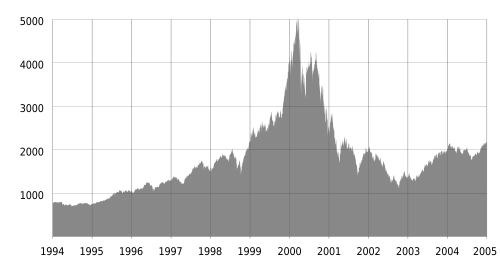 Photo: The NASDAQ composite chart reflecting the era of explosive tech IPOs that Clark helped ignite. Wikimedia Commons. License: CC BY-SA 3.0.
SGI’s machines were behind some of the most iconic visual effects in cinema history. The dinosaurs in Jurassic Park (1993) were rendered on SGI workstations. The liquid-metal T-1000 in Terminator 2: Judgment Day (1991) was created using SGI hardware and software. The company’s technology was so dominant that for a decade, the words “computer graphics” were practically synonymous with Silicon Graphics.
Clark saw the company’s potential clearly: SGI had incredible technology, but the board was content selling expensive workstations, while he wanted to bring graphics to everyone.
By the early 1990s, Clark was frustrated. He wanted SGI to build cheaper, consumer-oriented machines that could bring 3D graphics to ordinary people. The board disagreed. They were making enormous margins on high-end workstations and saw no reason to cannibalize their own business. In late January 1994, Clark departed Silicon Graphics, the company he had founded, amid widening differences with its management. It was a bitter departure — a pattern that would later repeat with Steve Jobs, who had been ousted from Apple a decade earlier, and which I have written about in examining founders who got fired from their own companies.
Meeting Marc Andreessen
After leaving SGI, Clark spent months looking for his next venture. He considered interactive television, online gaming, and several other ideas. Then he saw Mosaic — the graphical web browser that a 22-year-old named Marc Andreessen had built at the University of Illinois.
I spent ten years in hosting and came out of it knowing more about Linux servers than about business. That is the kind of lopsided education that builds employees, not founders — Clark, by contrast, was always looking past the technology to where the market was heading.
Clark recognized immediately what Mosaic represented. The web browser was not just a tool for viewing web pages — it was the gateway to the entire internet. Whoever built the best browser would control how hundreds of millions of people experienced the digital world.
In early 1994, Clark emailed Andreessen. They met at a coffee shop in Palo Alto. Clark was 49 years old, wealthy, experienced, and connected. Andreessen was 22, brilliant, broke, and bored at a dead-end job. Clark’s pitch was direct: “Let’s do a Mosaic killer.”
In April 1994, Clark flew to Illinois and helped Andreessen recruit the core NCSA engineering team. He provided the initial funding — reportedly $4 million of his own money — and the business acumen. Andreessen provided the technical vision and the team. Together, they founded Mosaic Communications Corporation, later renamed Netscape Communications.
 Photo: Reed Hastings, another founder who understood the power of digital transformation — a theme Clark pioneered. Wikimedia Commons. License: CC BY 2.0.
The Netscape Rocket
The Netscape IPO on August 9, 1995 was the moment that launched the internet economy. The stock opened at $71, nearly triple its offering price, and closed the day at $58.25. Netscape was valued at $2.9 billion. Clark’s stake was worth over $500 million on the first day.
The Netscape IPO proved to Wall Street that internet companies could generate enormous returns even before they were profitable. It was the starting gun for the dot-com boom — the period of frenzied investment, rapid company formation, and sky-high valuations that would define the second half of the 1990s.
Healtheon: The Third Billion-Dollar Company
Most people would have retired after building two billion-dollar companies. Clark did not. In 1996, he founded Healtheon, a company aimed at simplifying the American healthcare system by moving medical transactions — insurance claims, prescriptions, patient records — onto the internet.
The healthcare industry was, and remains, notoriously resistant to technological change. Clark believed that the same internet technologies that had disrupted media and retail could cut through the bureaucratic nightmare of healthcare administration. Healtheon went public in 1999 and merged with WebMD to form one of the largest health-information companies on the internet.
With Healtheon, Clark became the first person in history to found three separate companies that each achieved a market capitalization of over $1 billion: Silicon Graphics, Netscape, and Healtheon. It was a record that would stand for years.
The Pattern of Reinvention
What I find most striking about Jim Clark is not the number of companies he built, but the fact that each one was in a completely different industry. Silicon Graphics was a hardware company serving Hollywood and science. Netscape was a software company that democratized the internet. Healtheon was a services company that tried to fix healthcare. The through-line was not a specific technology or market — it was Clark’s ability to see where technology was heading before everyone else and to build companies that rode the coming wave.
Clark’s story also underscores a truth about Silicon Valley that often goes unspoken: experience matters. Andreessen gets most of the credit for Netscape, but without Clark’s funding, connections, and business judgment, Mosaic might have remained an academic project. The partnership between a seasoned entrepreneur and a young technical genius was the formula that made Netscape possible — and it is a formula that Silicon Valley in 1995 would see repeated many times over.
Always Building
Jim Clark never stopped. After Healtheon, he funded companies in DNA sequencing, charter aviation, and photography software. He built a 156-foot computerized sailboat called Hyperion — and later a 292-foot schooner, Athena. He poured money into education and medical research.
But his greatest legacy is the insight that no single success defines you. Clark left the first company he built under difficult circumstances. Instead of bitterness, he channeled that energy into something bigger. And then he did it again. The ability to start over — to take everything you have learned and apply it to a new problem, in a new industry, with a new team — is the rarest skill in entrepreneurship. Jim Clark had it in abundance.
Sources
- Michael Lewis, The New New Thing: A Silicon Valley Story, W.W. Norton, 1999.
- Jim Clark with Owen Edwards, Netscape Time, St. Martin’s Press, 1999.
- “Jim Clark: The Man Behind the Netscape Fortune,” Fortune, 1996.
- Silicon Graphics corporate history, Computer History Museum archives.
- Healtheon/WebMD merger details, SEC filings, 1999.






.jpg)