I have been fascinated by the origin stories of today’s tech giants, and the more I dig into them, the more I realize that the popular narrative — genius founds company, company takes over the world — leaves out the most interesting part. The part where everything almost falls apart. No company illustrates this better than Amazon, which spent seven years losing money, endured a stock crash of over 90%, and was openly mocked by Wall Street before it became the empire we know today.
The Amazon story people tell is about inevitability. The real Amazon story is about survival.
The Garage, the Books, and the Post Office
Jeff Bezos launched Amazon on July 16, 1995, from a converted garage in Bellevue, Washington. He had left a comfortable job at the hedge fund D.E. Shaw in New York after seeing a statistic that web usage was growing at 2,300% per year. He reasoned that a growth rate that extreme would make internet commerce viable, and he chose books as his first product because there were more book titles in print — over three million — than any physical store could possibly stock.
The early days were scrappy in a way that feels almost comical given what Amazon would become. Bezos and his small team packed books on the floor, kneeling on concrete. When an employee suggested they get kneeling pads, Bezos reportedly said they should get packing tables instead. He famously drove packages to the post office himself in his Chevy Blazer.
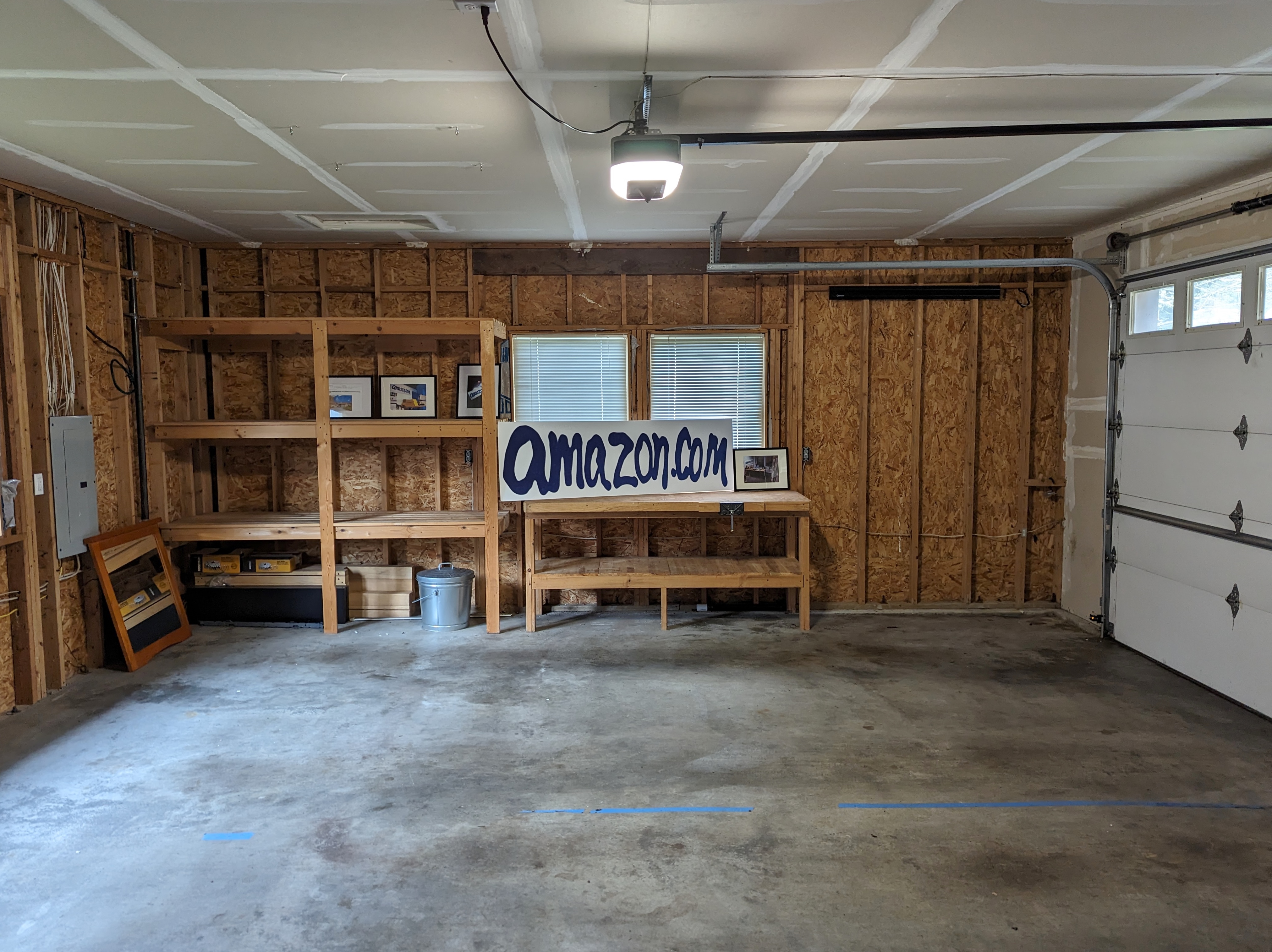 Photo: Wikimedia Commons. CC BY-SA 4.0. The garage where Jeff Bezos launched Amazon in 1995.
The desks were made from doors bought at Home Depot with two-by-four legs screwed into them — the now-legendary door desks. This was not a quirky design choice. It was a necessity. Bezos was obsessively focused on keeping costs low so he could keep prices low for customers. That obsession would define Amazon’s entire strategy, but in 1995, it just looked like a startup that could not afford proper furniture.
Growing Fast and Losing Faster
Amazon’s revenue growth was staggering. The company went from $15.7 million in 1996 to $148 million in 1997 to $610 million in 1998 to $1.6 billion in 1999. These numbers were staggering. No retail company in history had grown that fast.
But there was a problem that the revenue numbers obscured: Amazon was not making money. The losses widened alongside the revenue. Bezos was pouring every dollar back into the business — building warehouses, expanding into new product categories, investing in technology. His argument was simple and radical: market share now, profits later. Get big fast, build the infrastructure, and then turn the profit lever when you dominate the market.
Wall Street loved this story in the boom years. Amazon went public on May 15, 1997, at $18 per share. The stock climbed steadily, reaching a peak of roughly $107 per share in December 1999. Bezos was named Time magazine’s Person of the Year that same year. He was thirty-five years old, and he seemed to have figured out the future.
Then the dot-com bubble burst, and the story changed overnight.
“Amazon.bomb”
The Nasdaq crash that began in March 2000 devastated internet stocks across the board. Amazon was not spared. The stock, which had peaked near $107, began a relentless decline. By late 2001, it had fallen to roughly $6 per share — a drop of about 94% from its peak.
My hosting company failed to grow because I treated it like a job instead of a business. I showed up, did the work, went home. Founders like Bezos do not do that — even as his stock was collapsing, he was building fulfillment centers and planning for the next decade. They are always building, even when they are not at the office.
The media had turned hostile even before the crash. Barron’s ran a now-infamous cover story with the headline “Amazon.bomb” in May 1999, predicting the company’s demise. Analyst Ravi Suria at Lehman Brothers published a report in June 2000 arguing that Amazon would run out of cash within four quarters. The conventional wisdom was that Amazon was just another dot-com fantasy, destined to join the roughly 8,000 companies that died in the crash.
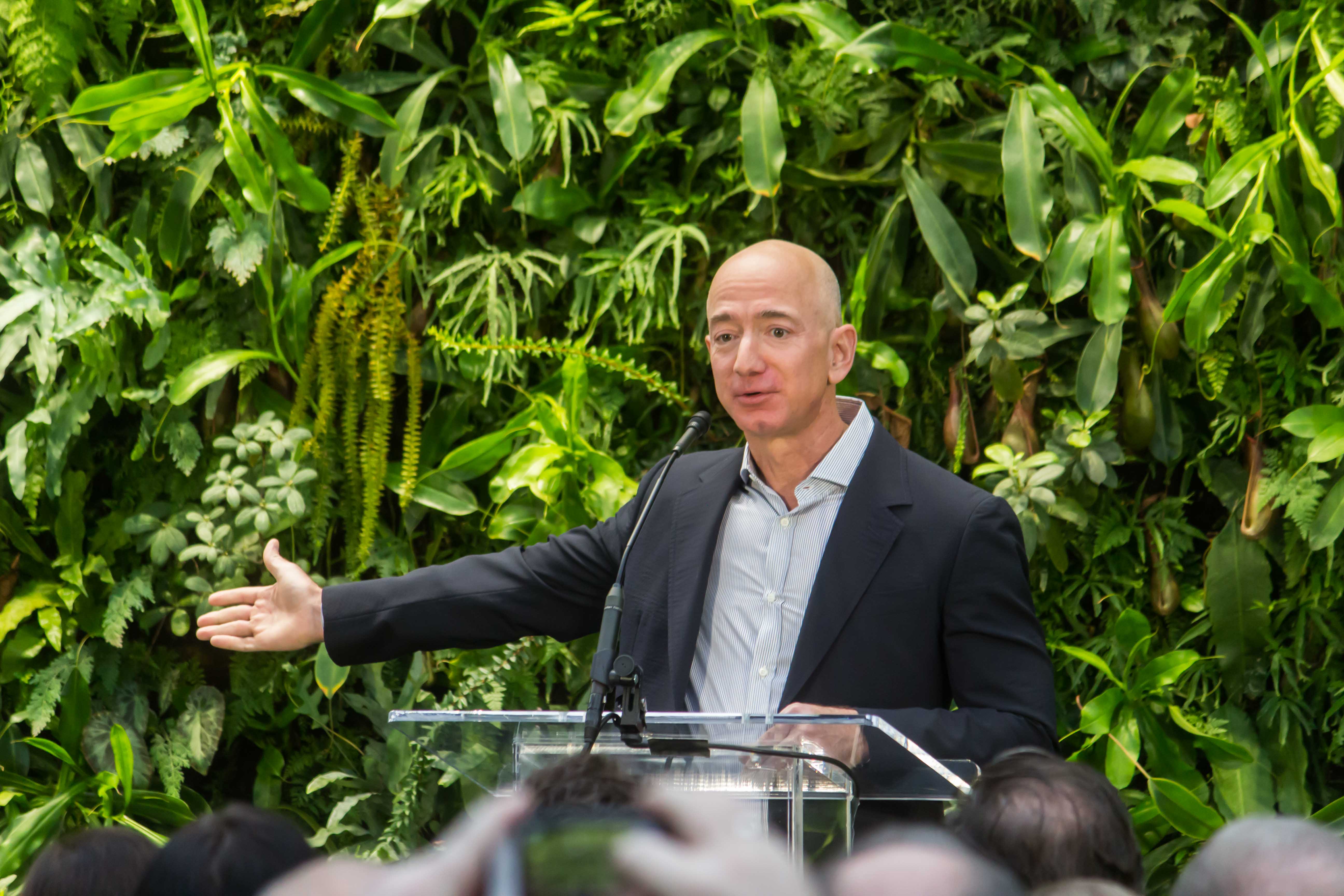 Photo: Wikimedia Commons. CC BY 2.0. Jeff Bezos years later at the Amazon Spheres in Seattle — a long way from the garage and the door desks.
Bezos responded to the panic with a message to employees that has become legendary in startup culture:
“We are not a stock, we are a company. If the stock is up 30%, don’t feel 30% smarter. And if it’s down 30%, don’t feel 30% dumber. Focus on customers.”
I find this remarkable not because it sounds good — plenty of CEOs say reassuring things during a crisis — but because Bezos actually meant it. He did not change strategy. He did not pivot to profitability to appease Wall Street. He kept investing in fulfillment centers, technology, and customer experience. He was playing a game measured in decades, and the market was measuring in quarters.
The Turning Point
The moment that vindicated Bezos’s long game arrived in Q4 2001, when Amazon reported its first-ever net profit: $5 million on revenue of $1.12 billion. It was a tiny profit — barely a rounding error — but it was real. After more than six years of continuous losses, Amazon had proven that the business model worked.
What made the difference? Several factors came together. Amazon had aggressively cut costs after the dot-com crash, laying off about 1,300 employees (roughly 15% of its workforce) in early 2001. It had also diversified far beyond books into electronics, toys, kitchen products, and tools — becoming the “everything store” that Bezos had always envisioned. And critically, the company’s third-party marketplace — allowing other retailers to sell on Amazon’s platform — was beginning to generate significant revenue with minimal overhead.
The stock began its recovery. Slowly at first, then with increasing momentum. Investors who had bought near the bottom in late 2001 would eventually see returns of over 50,000%. The door-desk startup from the Bellevue garage would grow into one of the most valuable companies in the history of capitalism.
The Long Game
I keep coming back to the timeline. Seven years of losses. A stock crash of more than 90%. Wall Street openly predicting your death. And through all of it, Bezos never wavered from his core conviction: obsess over customers, invest in infrastructure, and the profits will come.
This was not blind faith. It was a calculated bet grounded in a specific insight about the internet — that the early commercial web was creating entirely new possibilities for retail, and the company that built the best infrastructure and the largest selection would win. Bezos understood something that most of his critics missed: the internet was not just a new way to sell things. It was a new way to build a company, one where scale and data created compounding advantages that traditional retailers could never match.
The companies that started in garages and survived their early crises tend to share one trait: a founder who refused to abandon the long-term thesis when short-term conditions turned brutal. Amazon is the ultimate example. Seven years of losses were not a failure. They were the foundation. And the patience required to endure them — from Bezos, from his employees, and eventually from his investors — is what separates the companies that survive from the ones that become footnotes.
Sources
- Stone, Brad. The Everything Store: Jeff Bezos and the Age of Amazon. Little, Brown and Company, 2013.
- Barron’s. “Amazon.bomb.” Cover story, 1999.
- Suria, Ravi. Credit analysis report on Amazon.com. Lehman Brothers, June 2000.
- Amazon.com. Annual Reports, 1997-2002.
- Time magazine. “Person of the Year: Jeff Bezos.” December 27, 1999.
- Bezos, Jeff. “1997 Letter to Shareholders.” Amazon.com, 1997.
- Kantor, Jodi and David Streitfeld. “Inside Amazon: Wrestling Big Ideas in a Bruising Workplace.” The New York Times, August 15, 2015.