

I came across the Hotmail story while researching the mid-1990s startup boom, and one detail stopped me cold: Sabeer Bhatia sold Hotmail to Microsoft for $400 million on December 30, 1997 — his 29th birthday. The symmetry was almost too perfect. But the more I researched, the more I realized that the timing was the least remarkable thing about this story. What struck me was how a young engineer from Chandigarh, India, built a product that changed how the entire world communicates — and did it in under eighteen months.
How does a hardware engineer at Apple, with no experience in email systems, build the service that would eventually reach 400 million users?
Did you know? Hotmail’s $400 million sale came just months before AOL paid up to $407 million for ICQ — two web giants, two years apart, priced within a rounding error of each other.
Who Invented Hotmail?
Hotmail was invented by Sabeer Bhatia and Jack Smith in 1996, and launched on July 4, 1996 as the world’s first web-based email service. Bhatia and Microsoft sold it to Microsoft in December 1997 for $400 million.
From Chandigarh to Caltech
Sabeer Bhatia was born in Chandigarh, India, in 1968. His father was a captain in the Indian Army, and his mother was a senior official at the Central Bank of India. Bhatia attended St. Joseph’s High School and then BITS Pilani, one of India’s most prestigious engineering institutions. He then won a transfer scholarship to the California Institute of Technology (Caltech), where he earned a bachelor’s degree in electrical engineering, before completing his master’s at Stanford.
After Caltech, Bhatia joined Apple Computer as a hardware engineer. It was a good job — stable, respected, well-paid. But Bhatia was restless. He and his colleague Jack Smith, who worked at the same Apple division, spent their evenings brainstorming startup ideas. They originally wanted to build a web-based personal database — something like an online Rolodex. But there was a problem: their employer’s firewall blocked external email, which meant they could not communicate about their side project from work.
That frustration became the idea.
 Photo: A Compaq computer typical of the mid-1990s era when Hotmail was conceived. Wikimedia Commons. License: CC BY-SA 3.0.
HoTMaiL: The Name Was the Code
Bhatia realized that if he could access email through a web browser — instead of through a desktop email client like Outlook or Eudora — no corporate firewall could block it. You could check your email from any computer, anywhere, without installing software or configuring SMTP servers. It was a radical concept in 1996, when email was tied to specific machines and specific internet service providers.
Bhatia and Smith called their service HoTMaiL, deliberately capitalizing the letters H, T, M, and L — a reference to HTML, the language of the web. The name was clever, memorable, and technically meaningful all at once.
They launched on July 4, 1996 — Independence Day. The date was chosen deliberately, as a symbol of liberation from ISP-controlled email. This was the heart of the era I described in my piece on what Silicon Valley was actually like in 1995, when a new startup seemed to launch every week.
Bhatia framed the choice simply: the Fourth of July was about freedom — freedom from your ISP, freedom from your employer’s firewall, freedom to check your email from anywhere.
Venture Capital and Viral Growth
Bhatia and Smith pitched their idea to Draper Fisher Jurvetson, one of Silicon Valley’s top venture firms. Tim Draper offered $300,000 in seed funding. It was not a huge sum, but it was enough to hire a small team and launch the service.
If my hosting company were a person, its personality would be: reliable, predictable, and never the most interesting person in the room — the opposite of a product like Hotmail, whose entire growth engine depended on being noticed. That was exactly my personality as its owner. Companies reflect the people who build them.
What happened next was one of the earliest examples of viral growth in internet history. At the bottom of every email sent from a Hotmail account, the service automatically appended a small tagline: “Get your free email at Hotmail.” Every outgoing email was, in effect, an advertisement. Every Hotmail user became an unpaid marketer.
The result was explosive. Hotmail hit one million subscribers within six months of launch. By the end of 1997, it had more than 8.5 million users. Tim Draper later called the tagline strategy one of the most effective marketing tactics in the history of technology.
Microsoft Comes Knocking
Microsoft had been watching Hotmail’s growth with a mix of admiration and anxiety. The company was trying to build its own web-based email service, but Hotmail was already dominant. In late 1997, Microsoft made an acquisition offer.
The negotiations were intense. Microsoft’s offers escalated through $200 million, $250 million, and $300 million, with Bill Gates himself eventually offering $350 million — and Bhatia, at one point, holding out for $700 million. The two sides went back and forth for weeks before settling on $400 million in Microsoft stock. On December 30, 1997 — Bhatia’s 29th birthday — the deal was done.
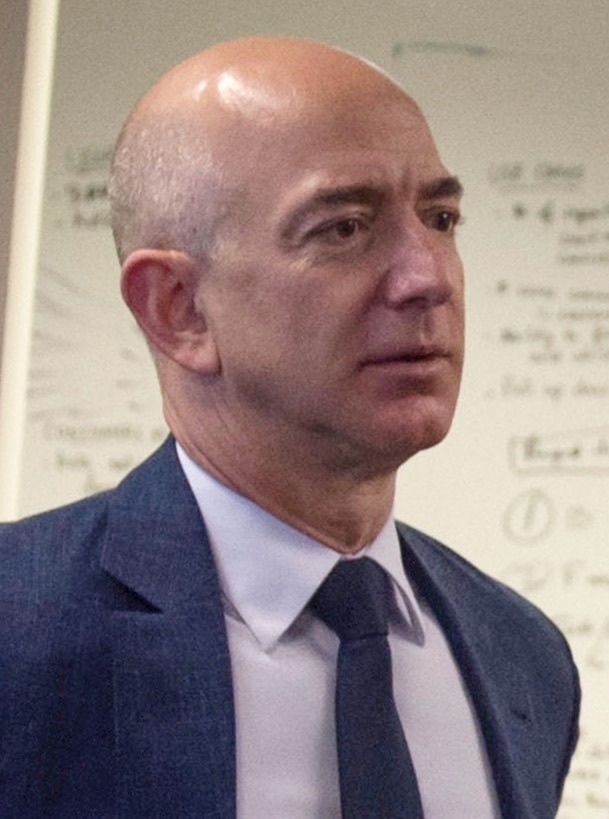
 Photo: Jeff Bezos at the Amazon Spheres — another immigrant-driven tech success story, paralleling Bhatia’s journey. Wikimedia Commons. License: CC BY 2.0.
Microsoft rebranded Hotmail as MSN Hotmail and eventually evolved it into Outlook.com. The core idea — email accessed through a browser, free, available from any device — became the standard that every email service would follow. Gmail, Yahoo Mail, and every other webmail platform built on the foundation that Bhatia and Smith laid.
The Immigrant Founder Pattern
What fascinates me about Bhatia’s story is how it fits into a broader pattern of immigrant founders in Silicon Valley. Like Jeff Bezos’s family, who came from Cuba, and like the Musk family, who left South Africa, Bhatia arrived in the United States with talent and ambition but no network, no family wealth, and no safety net. The willingness to take risks — to leave Apple for a startup, to hold out for $400 million when $200 million was on the table — was not recklessness. It was the confidence of someone who had already made the biggest bet of his life by moving to a new country.
Bhatia understood something fundamental about the internet era: access should be universal. Email had been trapped behind corporate firewalls and ISP subscriptions. Bhatia freed it. He made it possible for anyone with a web browser to communicate instantly, for free, from anywhere in the world.
The Birthday Deal That Changed Communication
Sabeer Bhatia’s journey — from Chandigarh to Caltech to Apple to Hotmail — is one of the great immigrant success stories of the internet age. He saw a problem that millions of people experienced every day, built a simple solution in under a year, and scaled it to more than eight million users before most people even understood what web-based email was.
The next time you open Gmail or Outlook in your browser, remember that the ability to do so exists because a young engineer from India got frustrated by a corporate firewall and decided to fix the problem himself. That impulse — see the friction, build the fix — is the engine that drives every great technology startup. Bhatia proved that you do not need a massive team or a massive budget. You need a clear insight and the nerve to act on it.
Sources
- “Sabeer Bhatia: The Man Behind Hotmail,” Inc. Magazine, 1998.
- Tim Draper, interview on the founding of Hotmail, Draper Fisher Jurvetson archives.
- Po Bronson, The Nudist on the Late Shift, Random House, 1999.
- “How Hotmail Changed Microsoft,” Wired, January 1998.
- Microsoft Corporation press release, “Microsoft Acquires Hotmail,” December 31, 1997.




.jpg)