

My flight was delayed by three hours last month, so I sat at the gate and started reading everything I could find about the Netflix culture machine. That is when I noticed something that kept bothering me. Every article, every documentary, every conference keynote about Netflix begins and ends with one name: Reed Hastings. But the more I dug, the more I found a second name in the footnotes, in the early filings, on the original business cards. That name was Marc Randolph. And when I traced the origin story back to its true beginning, I discovered that Netflix was not born in a boardroom or a Stanford lecture hall. It was born in a car.
What happens when the person who starts a revolution steps aside so quietly that the world forgets they were ever there?
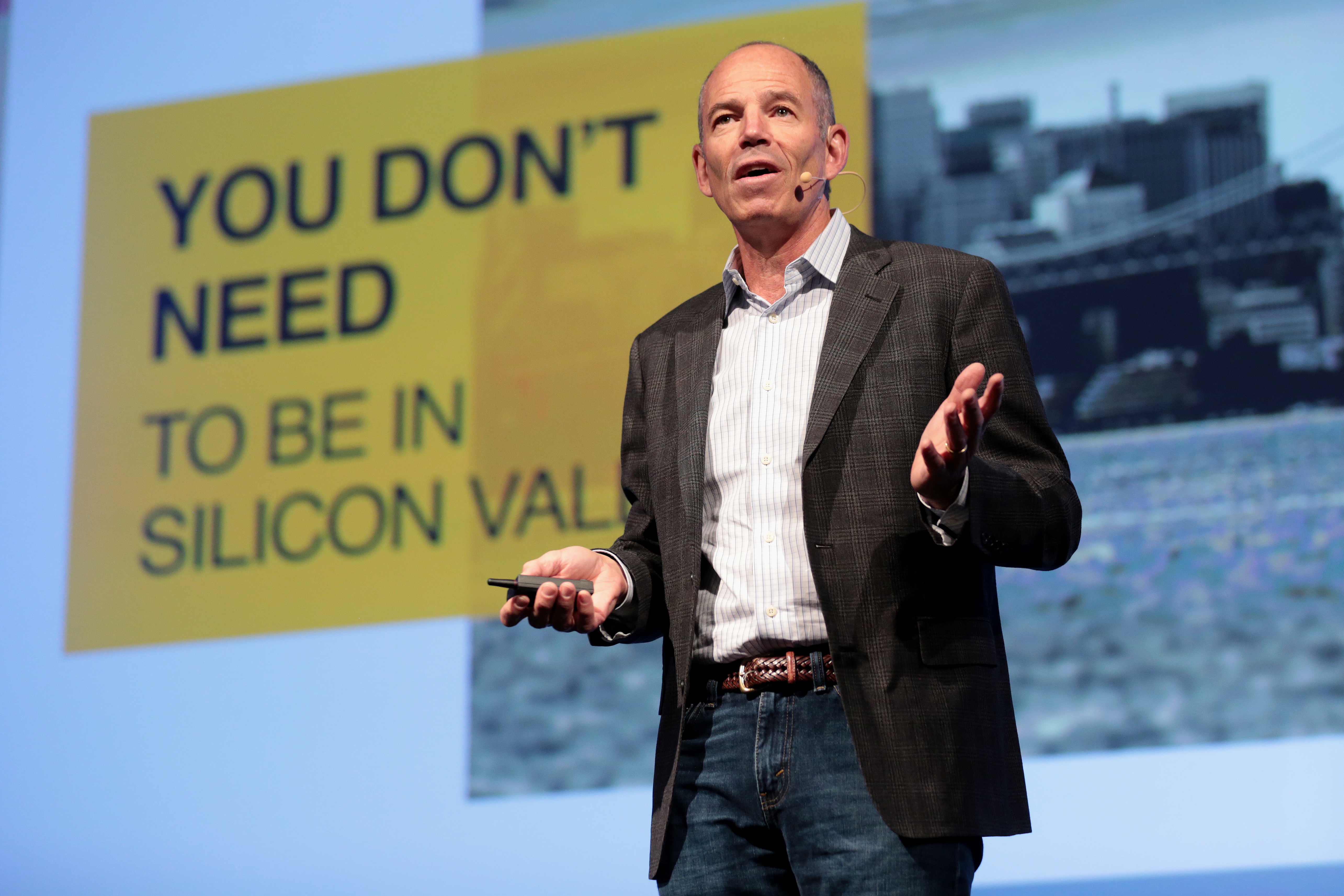 Photo: Wikimedia Commons. CC BY-SA 2.0.
The Carpool That Changed Entertainment
In 1997, Reed Hastings and Marc Randolph were both working at a company called Pure Atria, formed after a merger involving Hastings’ previous venture. They lived near each other in Santa Cruz, California, and they carpooled to work. The commute was about forty minutes each way, and they used the drive to pitch each other business ideas.
The ideas they tossed around were, by Randolph’s own account, mostly terrible. Personalized baseball bats. Custom-made surfboards. Shampoo delivered to your door by subscription. They were throwing concepts at the wall during those drives, trying to find something that stuck. This was not a eureka moment in a laboratory. It was two guys in a car, brainstorming to pass the time.
“We had terrible ideas. Personalized shampoo. Custom baseball bats. We were just riffing.” – Marc Randolph, That Will Never Work (2019)
Then Randolph landed on something: DVDs by mail. The DVD format had just launched in the United States in March 1997. DVDs were small, light, and flat, meaning they could be mailed in a standard envelope without breaking. VHS tapes could not do that. The timing was everything.
And there was a catalyst that has become part of Silicon Valley folklore: the $40 late fee. Hastings has told the story of being charged $40 by Blockbuster for a late return of Apollo 13. Whether the late fee was the actual spark or a narrative embellishment that emerged later is debated, but the frustration it represented was real. Video rental was an industry built on penalizing its own customers.
The First DVD and the First Dollar
Netflix launched on April 14, 1998, as an online DVD rental and sales service. But before the public launch, the team ran a critical test. In early March 1998, Randolph mailed himself a DVD to see if it would arrive intact. The disc he chose was Beetlejuice. It arrived in perfect condition, tucked inside a simple greeting card envelope. That test validated the entire business model.
On launch day, Netflix offered 925 titles, essentially every DVD available in the United States at the time. Customers could rent or buy DVDs through the website. The subscription model, the innovation that would eventually destroy Blockbuster, did not come until later. In the beginning, Netflix was simply a more convenient video store that happened to exist on the internet.
The founding year of 1997 was a remarkable moment in tech history. As I explored in my piece on the year that changed everything, Netflix was just one of several companies born that year that would go on to reshape entire industries. The internet was still young, the Netscape IPO had happened only two years earlier, and the rules of online commerce were still being written.
The Money and the Power
Here is where the founding story gets complicated. Hastings invested $2.5 million of his own money into Netflix. That investment gave him approximately 70% of the company’s equity. Randolph, who conceived the idea and served as the company’s first CEO, held a significantly smaller stake.
I understand this on a gut level. The gap between knowing something is true and acting on it is where most small companies — including mine — go to die.
I never had a cofounder. After reading about the Musk brothers, the PayPal Mafia, and every other founding team that worked, I think that was my biggest structural mistake.
This is not unusual in startup land. The person with the capital often holds more equity than the person with the idea. But it created a dynamic that would define Netflix’s early years: Randolph was the visionary and the operator, but Hastings was the majority owner and, increasingly, the strategic mind.
Randolph built the initial team. He hired the early employees, set the company culture, and oversaw the product development that turned an idea pitched in a carpool into a functioning business. He was the kind of founder who leads by enthusiasm and instinct, who believes in testing ideas quickly and iterating fast.
“The best way to find out if an idea is good is to build it, launch it, and see if anybody wants it.” – Marc Randolph, That Will Never Work (2019)
But as Netflix grew, the company needed a different kind of leadership. It needed someone who could raise institutional capital, negotiate with Hollywood studios, and build the kind of organizational discipline that turns a scrappy startup into a scalable enterprise. Randolph recognized this, and in 1999, he stepped aside as CEO and handed the role to Hastings.
Stepping Aside
I find this part of the story the most revealing. Randolph did not get fired. He did not get pushed out in a boardroom coup, the way other founders have been. He made a conscious decision that the company he had started needed a leader with different strengths. He stayed on as a board member and continued to contribute, but the spotlight, the magazine covers, the TED talks, those all went to Hastings.
Randolph eventually left Netflix entirely and went on to mentor startups, serve on boards, and in 2019, he published his memoir, That Will Never Work: The Birth of Netflix and the Amazing Life of an Idea. The title itself is a reference to what people told him when he first pitched the concept of DVDs by mail. The book is his reclamation of the story, told in his own voice, with his own memories of those early days in a car on the highway between Santa Cruz and Silicon Valley.
The Forgotten Co-Founder Problem
The tech industry has a pattern of forgetting its co-founders. We remember Steve Jobs but not Steve Wozniak in the same breath. We remember Bill Gates but Paul Allen fades into the background. We remember Mark Zuckerberg but the contributions of Eduardo Saverin, Andrew McCollum, Dustin Moskovitz, and Chris Hughes require a movie to surface.
Randolph fits this pattern perfectly. He was the idea person, the first builder, the original CEO. But the person who scaled the company, who turned it from a DVD mailer into a streaming giant worth over $200 billion, was Hastings. And in the public narrative, scale wins. The person who takes a company from a hundred customers to a hundred million customers gets the credit, even if someone else built it from zero to one.
This matters because the zero-to-one phase is often the hardest. It requires a kind of faith that the scaling phase does not. When Randolph mailed that first copy of Beetlejuice to himself, there was no proof that anyone would ever want to rent DVDs through a website. When Hastings took over as CEO, there were already customers, revenue, and a proven concept. Both contributions were essential. But only one gets remembered.
What Randolph Built
The Keeper Test, the culture of talent density, the radical transparency that Netflix became famous for, those are all associated with Hastings, and rightly so. He built the organizational philosophy that made Netflix one of the most admired companies in the world. But Randolph built the foundation: the original product, the original team, the original belief that an idea everyone dismissed could actually work.
As I explored in my article on what Netflix and PayPal have in common, the culture of talent density did not emerge from theory. It emerged from the experience of building something from nothing with a small team where every person mattered. Randolph was part of that original small team. He helped create the conditions that made the culture possible.
The Netflix story is often told as one person’s vision executed brilliantly. The truth is that it was two people, carpooling to work, throwing out bad ideas until one of them stuck. One of them became a billionaire household name. The other wrote a book to remind the world he existed. Both of them built Netflix.
Sources
- Randolph, M. That Will Never Work: The Birth of Netflix and the Amazing Life of an Idea. Little, Brown and Company, 2019.
- Hastings, R. and Meyer, E. No Rules Rules: Netflix and the Culture of Reinvention. Penguin Press, 2020.
- Keating, G. Netflixed: The Epic Battle for America’s Eyeballs. Portfolio, 2012.
- Hastings, R. “Blitzscaling 16: Reed Hastings on Building a Streaming Empire.” Stanford University. YouTube.
- McDonald, D. “The Netflix Effect.” Vanity Fair, February 2013.





.jpg)