I was reading a bedtime story to my kid the other night – some picture book about a rocket ship – and he asked me if Elon Musk read books as a kid too. I laughed and said something like, “That’s all he did.” Later, after he fell asleep, I went back to the research I have been doing on Musk’s childhood in Pretoria, his years at Queen’s University, his departure from South Africa at seventeen. And one thread keeps surfacing above everything else: the books. Not business books or productivity manuals, but science fiction novels and an encyclopaedia. The reading habit that consumed Musk’s childhood did not just pass the time. It built the operating system he has been running on ever since.
Ten Hours a Day
According to Ashlee Vance’s 2015 biography, the young Musk read for ten hours a day. On weekends, he could tear through two books in a single day. When he exhausted the local library and the nearby bookshops, he turned to the Encyclopaedia Britannica — and read the entire thing. Once he finished it, the question was not whether to keep reading, but what to read next.
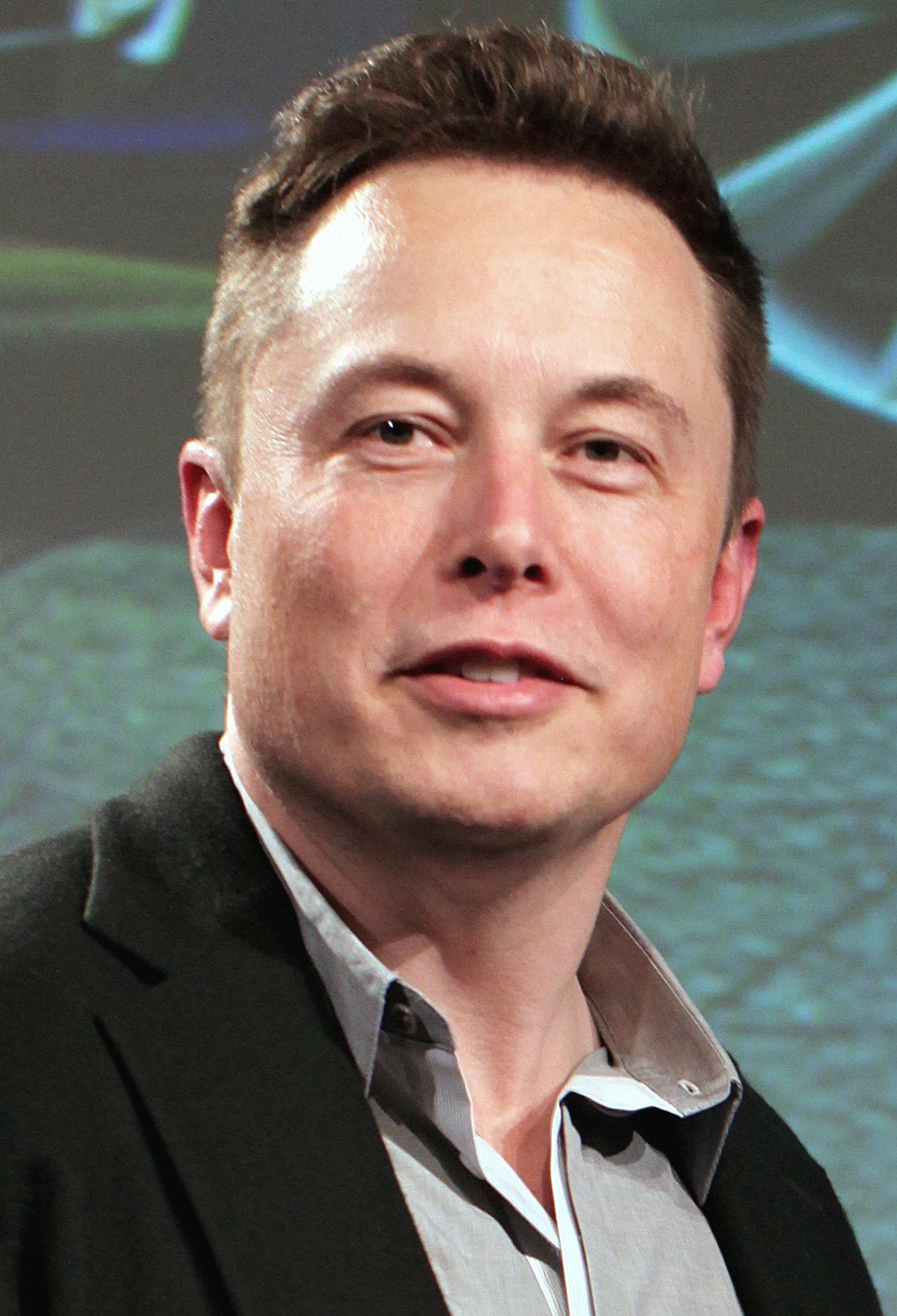 Photo by Steve Jurvetson, Wikimedia Commons. License: CC BY 2.0.
His mother Maye Musk described the intensity in terms that anyone who has watched a child disappear into a book will recognize — except that Musk took it further than most. As she told Vance: “He goes into his brain, and then you just see he is in another world.” At school, teachers and classmates thought something was wrong. He would slip into a trance-like state, completely oblivious to the people around him. Doctors tested his hearing. It was fine. He was just thinking.
This was not casual reading. It was a form of self-education so total that it replaced the world around him. And the books he chose were not random. Every title on his favorites list points toward the same set of questions: What is the purpose of civilization? What threatens it? And what can one person — or a small group of committed people — do about it?
The Reading List That Built a Worldview
Four books stand out as the ones that shaped Musk most deeply.
The Lord of the Rings by J.R.R. Tolkien gave him the quest narrative — the idea that ordinary individuals can take on a world-shaping mission. Musk was so taken with Tolkien’s world that he tried to write his own fantasy stories as a boy. As he told Vance, “I wanted to write something like Lord of the Rings.” He never finished those stories, but the archetype stuck: a small fellowship, a seemingly impossible task, a refusal to give up.
The Foundation series by Isaac Asimov left perhaps the deepest mark. Asimov’s saga spans thousands of years and centers on a mathematician named Hari Seldon who develops psychohistory — a way to predict and shape the future by understanding the large-scale patterns of human behavior. When Seldon foresees the collapse of a galactic empire, he does not try to stop it. Instead, he creates a Foundation designed to preserve human knowledge and shorten the coming dark age from thirty thousand years to a single millennium. The parallels to Musk’s stated mission — making humanity a multi-planetary species as insurance against civilizational collapse — are hard to miss. Asimov’s Foundation is, in a very real sense, the literary blueprint for SpaceX.
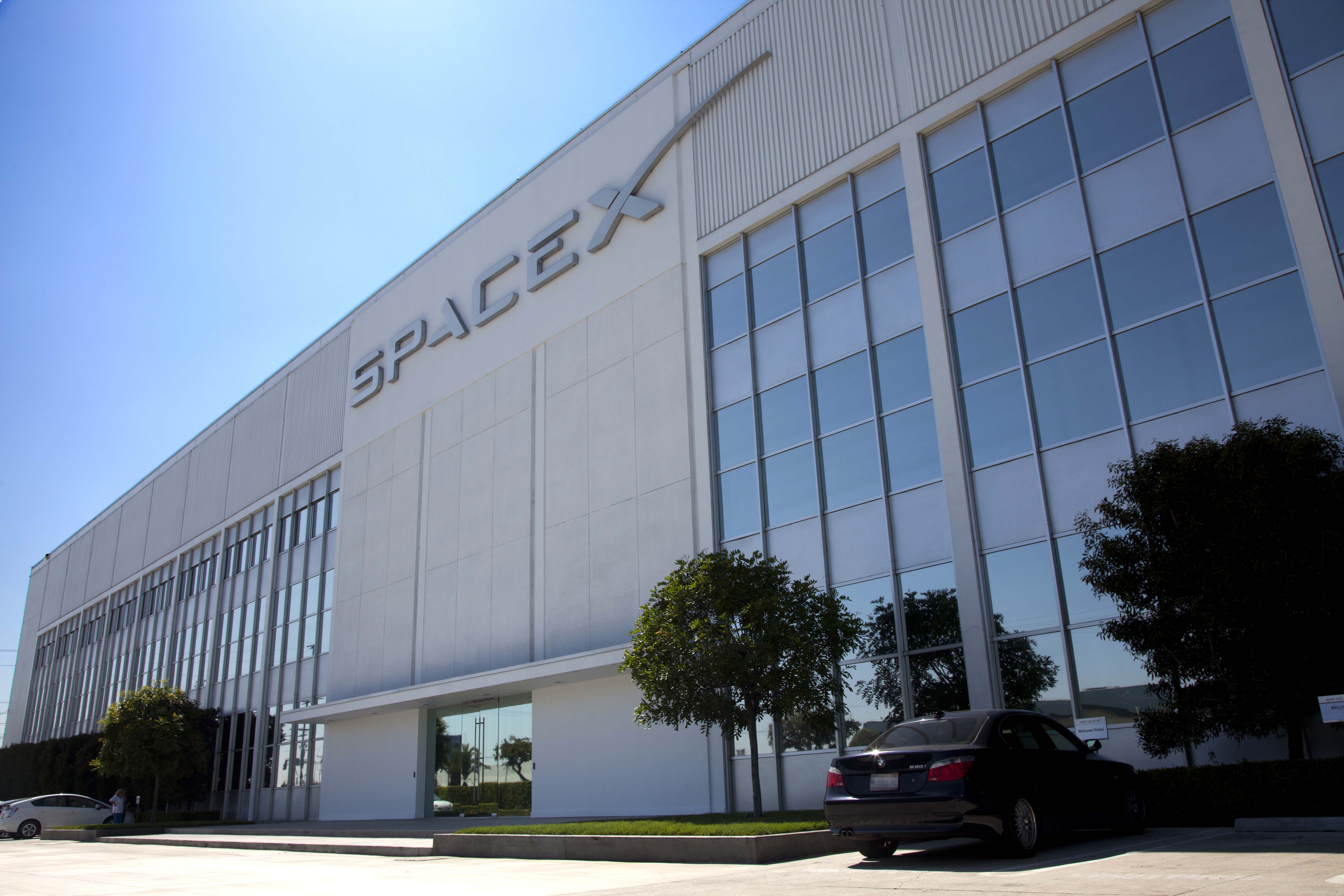 SpaceX headquarters in Hawthorne, California. Photo via Wikimedia Commons. License: CC BY-SA 3.0.
The Moon Is a Harsh Mistress by Robert Heinlein added a political dimension. Heinlein’s novel is set on a lunar colony that revolts against Earth’s control — a story of self-governance, resourcefulness, and the belief that human settlements beyond Earth are not just possible but necessary. For a teenager already absorbing Asimov’s interplanetary thinking, Heinlein made the idea tangible. Colonies are not abstractions. They are places where people live, work, and fight for their freedom. Decades later, when Musk talks about Mars governance, the echoes of Heinlein are unmistakable.
And then there was the book that changed everything.
The Hitchhiker’s Guide and the Existential Crisis
Around age fourteen, Musk hit a wall. He had been reading voraciously, but now he turned to philosophy — Nietzsche, Schopenhauer, Heidegger — and found them profoundly depressing. He was trying to answer a question that most teenagers do not yet know how to ask: What is the point of all this?
I closed my company at the right time. Not because the market was dying, but because I had run out of ideas for what to do with it. That is a specific kind of entrepreneurial death that nobody writes articles about — my own quiet version of the existential crisis Musk hit at fourteen.
“I almost had an existential crisis trying to figure out ‘What does it all mean? What’s the purpose of things?’” — Elon Musk, quoted in Eric Jorgenson, The Book of Elon
Then he picked up The Hitchhiker’s Guide to the Galaxy by Douglas Adams. For anyone unfamiliar, Adams’s novel features a supercomputer that spends millions of years calculating the Answer to the Ultimate Question of Life, the Universe, and Everything. The answer turns out to be 42 — which is meaningless, because nobody actually knows what the question was.
Most people read that as a joke. Musk read it as a philosophical breakthrough.
“What I think Douglas Adams was saying in The Hitchhiker’s Guide to the Galaxy is ‘The universe is the answer.’ We need to figure out what questions to ask about the answer that is the universe.” — Elon Musk, quoted in Jorgenson, The Book of Elon
This reframing — that the universe itself is the answer, and our job is to figure out the right questions — pulled Musk out of his existential crisis and gave him a framework he has never abandoned. If we do not understand enough about the universe, we cannot even ask the questions that matter. Therefore, the most important thing a person can do is expand the scope and scale of human consciousness.
“I came to the conclusion that if we can advance the knowledge of the world — if we can do things that expand the scope and scale of consciousness — then we’re better able to ask the right questions and become more enlightened. That’s the only way forward.” — Elon Musk, quoted in Jorgenson, The Book of Elon
That is a remarkable resolution for a teenager to reach. And it is the resolution that would drive every major decision of his adult life.
From Reading to a Life Plan
By the time Musk reached college, his childhood reading had crystallized into something concrete. He did not just have favorite books anymore — he had a mission derived from those books.
“In college, I would wonder about the future and what areas were really going to have an important impact on the future of humanity as a whole. This wasn’t for a paper, just what I thought about in the shower. I came up with five areas.” — Elon Musk, quoted in Jorgenson, The Book of Elon
Three of those areas — the Internet, renewable energy, and space — became the foundations of his career. Zip2 and PayPal addressed the first. Tesla and SolarCity addressed the second. SpaceX addressed the third. Each one traces back to the same underlying principle: expand human knowledge, extend human reach, increase the odds that consciousness survives.
What strikes me most about this story is how directly and how literally Musk’s reading maps to his actions. Asimov’s Foundation is about preserving civilization across collapse — and Musk builds rockets to make humanity multi-planetary. Heinlein’s lunar colony is about self-sufficient life beyond Earth — and Musk designs Starship for Mars. Adams’s Hitchhiker’s Guide says the universe is the answer and we need better questions — and Musk frames his entire career around expanding consciousness to ask those questions.
Most people read science fiction and enjoy the story. Musk read science fiction and treated it as a to-do list.
The Boy Who Disappeared Into Books
There is something worth sitting with in Maye Musk’s description of her son vanishing into his own mind. That ability to completely tune out the world — to ignore teachers, classmates, even doctors checking his hearing — is not just a quirk. It is the same capacity that would later allow Musk to sleep on factory floors, work hundred-hour weeks, and maintain focus on problems that most people would abandon after the first failure.
The books did not just give Musk ideas. They gave him the habit of deep, uninterrupted thought. They trained him to hold entire worlds in his head — fictional ones at first, and then real ones. The boy who read the Encyclopaedia Britannica cover to cover was building the same muscle he would later use to learn rocket engineering from textbooks, battery chemistry from first principles, and tunnel boring from YouTube videos and technical papers.
I find it reassuring, in a way, that the trajectory of one of the most consequential careers in modern technology was set not by a prestigious school, a wealthy mentor, or a lucky break — but by a kid in Pretoria who could not stop reading. The books are still there. The questions they raise are still worth asking. And the idea that expanding what we know is the most important thing we can do — that holds up.
Sources
- Vance, Ashlee. Elon Musk: Tesla, SpaceX, and the Quest for a Fantastic Future. Ecco/HarperCollins, 2015. Chapter 2.
- Jorgenson, Jeremy. The Book of Elon. 2020.
- Adams, Douglas. The Hitchhiker’s Guide to the Galaxy. Pan Books, 1979.
- Asimov, Isaac. Foundation. Gnome Press, 1951.
- Heinlein, Robert A. The Moon Is a Harsh Mistress. G.P. Putnam’s Sons, 1966.
- Tolkien, J.R.R. The Lord of the Rings. Allen & Unwin, 1954-1955.