
I was sitting on my balcony the other evening, watching the sun go down, and a thought kept nagging at me from a conversation I had at work that day. My manager had just overruled a decision I had spent two weeks preparing. Good data, solid reasoning, and he killed it in five minutes because “it needs to go through me first.” That night I went back to a story about Netflix that had been sitting in my reading pile. Adam Del Deo, Netflix’s director of original documentary programming, was at the Sundance Film Festival in January 2017. He had just watched Icarus, a documentary about the Russian doping scandal. It was, by his assessment, one of the greatest documentaries he had ever seen.
Amazon, Hulu, and HBO wanted it too. Adam had bid $2.5 million that morning — already a record for a documentary — but learned the bid was too low. Should he go to $3.5 million? $4 million? No documentary had ever sold for that much.
He and his colleague Rob Guillermo were agonizing in the lobby when Ted Sarandos, Netflix’s chief content officer (and Adam’s boss’s boss), walked through on his way to breakfast.
 Photo: Wikimedia Commons. CC BY 2.0.
“Is It THE ONE?”
Adam told Ted about the Icarus situation. The conversation went like this, as Adam recalls it in No Rules Rules:
“Maybe we’ll go up to $3.75 or $4 million, but that’s a huge amount to offer for a doc. It would completely reset the market,” Adam said.
Ted looked him square in the eye and said, “Well, is it ‘THE ONE’?” He made quote marks with his fingers, like it meant something important.
“What do you think, Ted?”
Ted started moving toward the door. “Listen. It doesn’t matter what I think. You’re the doc guy, not me. We pay YOU to make these decisions. But ask yourself if it’s THE ONE. If it’s not, that’s too much to pay. But if it is THE ONE you should pay whatever it’s going to take.”
And then Ted walked out of the lobby.
Adam bid $4.5 million, later raised it to $5 million. Netflix got Icarus. It won the Academy Award for Best Documentary Feature in 2018.
Control vs. Context
At any other company in Hollywood, this deal would have required layers of approval. The director would pitch the SVP, who would pitch the EVP, who would present to the CEO, who would consult with finance. The process would take days — by which time Amazon would have signed the deal.
At Netflix, a director-level employee made a five-million-dollar decision in a hotel lobby, with nothing more than a one-minute conversation with his boss’s boss. No approval form. No committee meeting. No financial model reviewed by a CFO.
This is what Netflix means by “Lead with context, not control.”
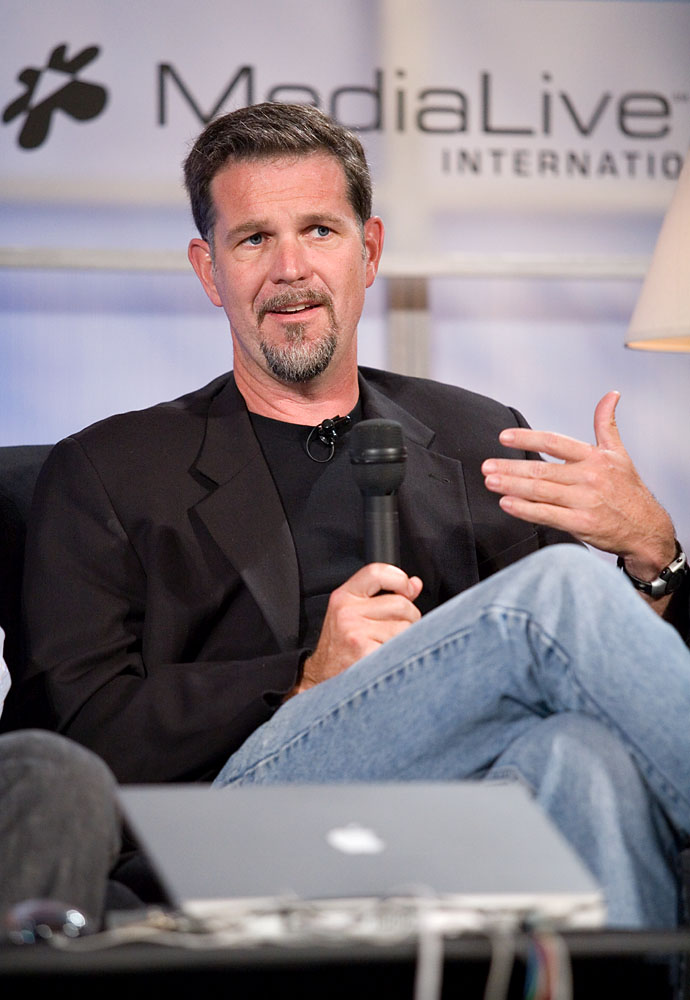 Photo: Wikimedia Commons. CC BY 2.0.
Hastings explains the distinction clearly: leadership with control means the boss approves and directs — telling employees what to do, checking work before it ships, monitoring progress against KPIs. Leadership with context means the boss provides information, strategy, and alignment — then trusts the employee to make the right call.
“Leading with control is great for error prevention. But if, like Target, your goal is innovation, making a mistake is not the primary risk. The big risk is becoming irrelevant because your employees aren’t coming up with great ideas.” — Reed Hastings, No Rules Rules
The Pyramid and the Tree
Melissa Cobb, Netflix’s VP of original animation (formerly producer of Dreamworks’ Kung Fu Panda), uses two metaphors to explain the difference between her old companies and Netflix.
At her previous studios, decision-making was a pyramid. Forty-five creative executives sat at the bottom, handling day-to-day decisions. But anything significant — a scene cut, a dialogue change, a casting choice — had to be pushed up through directors, VPs, SVPs, until it reached the CEO at the tiny triangle on top.
At Netflix, decision-making is a tree. The senior leaders are the roots, providing nutrients (context) — the company’s strategy, market data, competitive landscape. The individual employees are the branches, growing outward and making decisions at the edges. The tree grows faster than the pyramid because information doesn’t have to travel up and down a hierarchy.
Reed Spends 750 Hours a Year on Alignment
The catch is that leading with context requires enormous upfront investment in alignment. If Adam Del Deo didn’t deeply understand Netflix’s content strategy, competitive position, and financial parameters, Ted’s “Is it THE ONE?” question would have been useless.
Hastings invests approximately 750 hours per year — nearly a quarter of his working time — in setting context. He holds Quarterly Business Reviews with the top 10-15% of the company, E-Staff meetings with his direct reports, and individual thirty-minute meetings with every director (three to five levels below him) once a year. That’s about 250 hours of one-on-one alignment meetings alone.
“These one-on-one meetings help me to better understand the context in which our employees are working, and alert me to areas where our leadership is not aligned.” — Reed Hastings, No Rules Rules
The purpose is not to make decisions. It’s to ensure that when an Adam Del Deo stands in a hotel lobby and needs to bid $5 million in sixty seconds, he already knows everything he needs to know to make the right call without calling anyone.
The Five-Year Plan That Got Killed
The system has teeth. Hastings tells a story about visiting Netflix’s Singapore office in March 2018. During a one-on-one with a product development director, the man casually mentioned he was developing a five-year head count plan.
Hastings wanted to say: “You bozo! Don’t prioritize error prevention over flexibility! That is a total waste of time.” But that would have been leading with control. Instead, he added the topic to the next QBR meeting and had all 350 directors debate why long-term planning conflicts with Netflix’s need for adaptability.
The five-year plan was abandoned — not because the CEO ordered it, but because the entire leadership team discussed and aligned on why it was wrong.
Why Most Companies Can’t Do This
Leading with context requires four conditions, and most companies only have one or two:
- High talent density — you need employees good enough to make excellent decisions independently
- High candor — you need colleagues who will call out bad decisions before they become disasters
- Loose coupling — decision-making must be decentralized, not dependent on cascading approvals
- High alignment — everyone must share the same understanding of strategy and priorities
If you lead with context in a low-talent-density environment, you get chaos. If you lead with context in a tightly-coupled organization, the decisions conflict. Netflix built the preconditions first — talent density, candor, no bonuses, the Keeper Test — and only then removed the controls.
The reward? A director-level employee can spend $5 million in a hotel lobby, win an Oscar, and the CEO finds out after the fact. That’s not recklessness. That’s what it looks like when an organization trusts its people enough to let them do their jobs.
Sources
- Reed Hastings and Erin Meyer, No Rules Rules: Netflix and the Culture of Reinvention, Penguin Press, 2020 (Chapter 9: Lead with Context, Not Control)