It was a rainy Saturday morning, I had nowhere to be, and I was going through Reed Hastings’ career timeline with a cup of coffee – the founding of Netflix, the streaming revolution, the global expansion – when a pattern emerged that I had not noticed before. Every major chapter of his life, no matter how different it looked on the surface, traced back to the same thing. Teaching.
What if Netflix, the company that redefined entertainment for half a billion people, was never the point? What if it was just the funding mechanism for something far more personal?
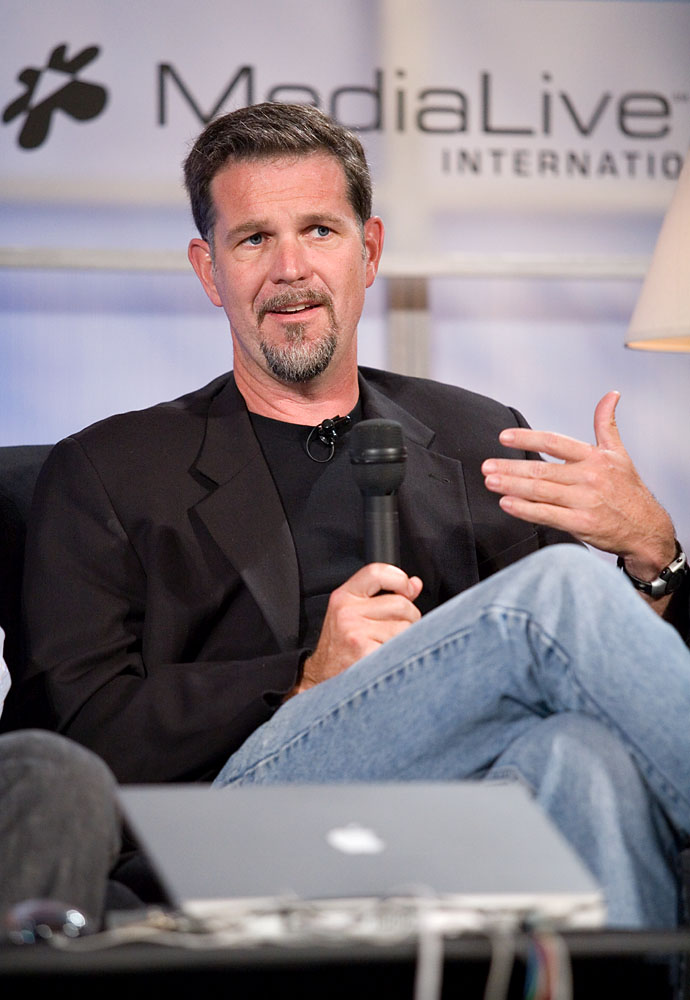 Photo by James Duncan Davidson, Wikimedia Commons. License: CC BY 2.0.
The Teacher Before the Founder
Before Reed Hastings was a billionaire, before he was a tech CEO, before he ever mailed a DVD, he was a Peace Corps volunteer in Swaziland. As I wrote in my article on how the Peace Corps shaped Reed Hastings, he taught high school math. He lived in a developing country, stood in front of classrooms, and experienced firsthand what education can and cannot do when resources are scarce.
That experience shaped everything that followed. Not in the vague way that people reference formative experiences in commencement speeches, but in a concrete, traceable, financial way. Hastings did not just talk about education after getting rich. He built his entire philanthropic identity around it — and the scale is staggering.
Hastings describes himself as an educator at heart — someone who thinks of Netflix as an expression of what great teams can do but who always keeps education as the real passion. I wondered how deep that commitment actually went, so I followed the money. The numbers tell a story that no press release captures on its own.
The Billion-Dollar Donation
In January 2024, Hastings donated $1.1 billion in Netflix stock to the Silicon Valley Community Foundation. Let that number settle for a moment. One point one billion dollars. It was one of the largest individual charitable contributions in American history, and it came just months after he stepped down as co-CEO of Netflix in early 2023.
The timing was not a coincidence. Hastings had been a member of the Giving Pledge since 2012 — the commitment, started by Warren Buffett and Bill Gates, where billionaires pledge to give away the majority of their wealth during their lifetimes. For over a decade, Hastings had been building toward this moment. Stepping away from Netflix freed him to execute on the mission he had been planning all along.
But the $1.1 billion was not the beginning of his giving. It was the culmination.
The HBCU Donation That Made History
In June 2020, in the midst of a national reckoning with racial inequality, Hastings and his wife Patty Quillin made a donation that sent shockwaves through higher education. They gave $120 million to Historically Black Colleges and Universities — split among the United Negro College Fund, Morehouse College, and Spelman College.
At my company, I had all the freedom in the world and I used it to build exactly the same thing every other small hosting company was building. Hastings had the same freedom and pointed it at a classroom. Freedom without vision is just comfortable stagnation.
At the time, it was the largest individual donation to HBCUs ever made. Not from a foundation. Not from a corporation. From a single person.
“Both of us had the privilege of a great education and we want to help more students — in particular, Black students — get a great education.”
— Reed Hastings and Patty Quillin, joint statement
I find the specificity of this donation revealing. Hastings did not give to a generic education fund. He identified institutions that had been systematically underfunded for generations and directed resources there with precision. HBCUs produce a disproportionate share of Black professionals in STEM, medicine, and law, despite receiving a fraction of the funding that predominantly white institutions receive. Hastings understood where the money would do the most good.
AI, Humanity, and the Future of Education
In March 2025, Hastings donated $50 million to Bowdoin College — his alma mater — to establish the Hastings Initiative for AI and Humanity. This was not a nostalgic gift to the old school. It was a forward-looking investment in one of the most consequential questions of our time: how do we ensure that artificial intelligence serves human flourishing rather than undermining it?
The initiative funds research, faculty positions, and curriculum development at the intersection of AI ethics, policy, and education. It is the kind of donation that reveals a donor thinking not just about today’s problems but about the problems that will define the next several decades.
What strikes me about this gift is how it connects to the rest of Hastings’ philanthropy. Education is not just about access — it is about preparing people for the world they are going to live in. And the world ahead is going to be shaped by AI more than any other technology. Hastings is funding the people who will help us make sense of that.
The Long Game: Charter Schools and Systemic Change
The headline donations are impressive, but they only tell part of the story. Hastings has been deeply involved in education reform for over two decades, and much of that work has been controversial, unglamorous, and intensely political.
The same philosophy that produced the Netflix culture deck — freedom paired with accountability — shows up in his approach to education reform. He founded Aspire Public Schools, a network of charter schools serving low-income communities in California and Tennessee. He was an early and significant funder of the NewSchools Venture Fund, which invests in education entrepreneurs building new school models. He spent $15 million of his own money supporting political candidates who backed charter school expansion.
Why Charter Schools?
I wondered why Hastings was so drawn to the charter school movement specifically, and his reasoning connects directly to his philosophy at Netflix. He believes in systems that reward performance and eliminate mediocrity. Charter schools, at their best, operate with more freedom than traditional public schools but are held accountable for results. They can be shut down if they fail. That is the Keeper Test applied to institutions instead of individuals.
Not everyone agrees with this approach, and the charter school debate is far from settled. But the consistency of Hastings’ worldview is undeniable. Whether he is running a streaming company or funding a school, the underlying principle is the same: give talented people freedom, hold them accountable for outcomes, and remove the ones who are not delivering.
I covered this philosophy in detail in my article on The Secret Strategy to Success of Netflix, where I traced how the Keeper Test and talent density became the foundation of Netflix’s culture. Seeing that same philosophy show up in Hastings’ philanthropy makes the pattern unmistakable.
The Through-Line of an Entire Life
A young man joins the Peace Corps and teaches math in Swaziland. He comes home and builds a software company. He sells it and starts Netflix. He turns Netflix into a global streaming giant worth hundreds of billions of dollars. He steps down. And then he gives the money away — almost all of it to education.
Hastings has called education the civil rights issue of our generation. That is not a pivot. That is a circle closing. The man who taught math in a developing country never stopped being a teacher. He just figured out how to fund the classroom at a scale that a Peace Corps volunteer could never have imagined.
$1.1 billion to the Silicon Valley Community Foundation. $120 million to HBCUs. $50 million to Bowdoin for AI and humanity. Decades of work on charter schools, education startups, and political advocacy. The total giving exceeds $1.6 billion and counting.
Some people build companies to get rich. Some people get rich and then figure out what to do with the money. Hastings appears to have known what to do with the money before he ever had it. Netflix was the vehicle. Education was always the destination.
I find that deeply compelling. In a world where billionaire philanthropy is often criticized — sometimes fairly — as performative or self-serving, Hastings’ giving has a coherence that is hard to dismiss. The thread runs from a classroom in Swaziland in the 1980s to a $50 million AI ethics initiative in 2025. That is not a PR strategy. That is a life’s work.
And for anyone who has ever wondered whether building a successful company can serve a purpose beyond shareholder value — I think Hastings answered that question a long time ago. He just had to build Netflix first to prove it.