
A friend of mine launched his startup last month, and at the party afterward I asked him what his policy was on sharing financials with the team. He looked at me like I had suggested he hand out his bank password. “Why would I do that?” he said. I told him about something I had read in No Rules Rules that completely changed how I think about it. Erin Meyer, the book’s co-author, describes sending the first draft of the first chapter to Reed Hastings for his feedback. The next week, she was interviewing a manager at Netflix’s Amsterdam office. Mid-conversation, the manager casually referenced a specific passage from the draft.
Meyer was stunned. “Reed sent that chapter out to everyone,” the manager explained.
“‘All Netflix employees?’ I asked. ‘Well not everyone, just the top seven hundred managers. He was showing us what the two of you are up to.’” — Erin Meyer, No Rules Rules
Meyer’s first instinct was horror. She hadn’t fact-checked the chapter yet. What if there were errors? What if quotes were wrong? But as she reached for the phone to confront Reed, she imagined his response: “You don’t want me to send out unfinished chapters? Why not?” And she realized she had no convincing answer.
This is what transparency looks like at Netflix. Not as a buzzword on a wall. As a reflex so deep it extends to sharing unfinished book manuscripts with hundreds of people.
 Photo: Wikimedia Commons. CC BY 2.0.
The Gecko in the Conference Room
The origin of Netflix’s transparency culture traces back to 1989, before Netflix existed. Reed Hastings was a twenty-nine-year-old software engineer at a startup called Coherent Thought. One Friday morning, he arrived at his cubicle and saw senior management standing huddled in the conference room through the glass wall. Their bodies were frozen. Their lips were moving frantically.
“What startled me was how still they were. On a recent trip, I had watched a gecko about to be devoured by a large white egret. He froze in terror with one leg midair. That was how these managers looked.” — Reed Hastings, No Rules Rules
The managers were back the next day. And the day after that. Hastings never found out what they were discussing, but the secrecy bred resentment. “I resented bitterly that they didn’t trust me enough to tell me what was going on,” he recalled.
That experience shaped a conviction: secrets destroy trust. At Netflix, Hastings resolved to share everything.
What “Open the Books” Actually Means
At Netflix, “opening the books” goes far beyond what most companies mean by transparency:
No locked offices. Hastings doesn’t have a private office. He doesn’t have a cubicle with drawers that close. He takes meetings on open balconies within earshot of anyone walking by. When Meyer arrived for her first interview, she expected a conference room with a door. Instead, Reed led her to an outdoor table where employees strolled past continuously. He talked about selling vacuum cleaners door-to-door, fistfights in junior high, and early challenges in his marriage — his voice never dropped a decibel.
Financial transparency. Before Netflix’s quarterly earnings are publicly released, Hastings shares the numbers with all employees — not just executives. Hundreds of people know the revenue, subscriber counts, and strategic outlook before Wall Street does. The legal risk is real: any employee could leak the data and trigger an SEC investigation. Netflix accepts that risk.
No information hierarchy. When a product development director in Singapore started developing a five-year headcount plan, Hastings didn’t issue an order to stop. He added the topic to the next Quarterly Business Review and had 350 directors debate why long-term planning conflicts with Netflix’s need for flexibility. The plan was abandoned — not because the CEO said so, but because everyone understood why.
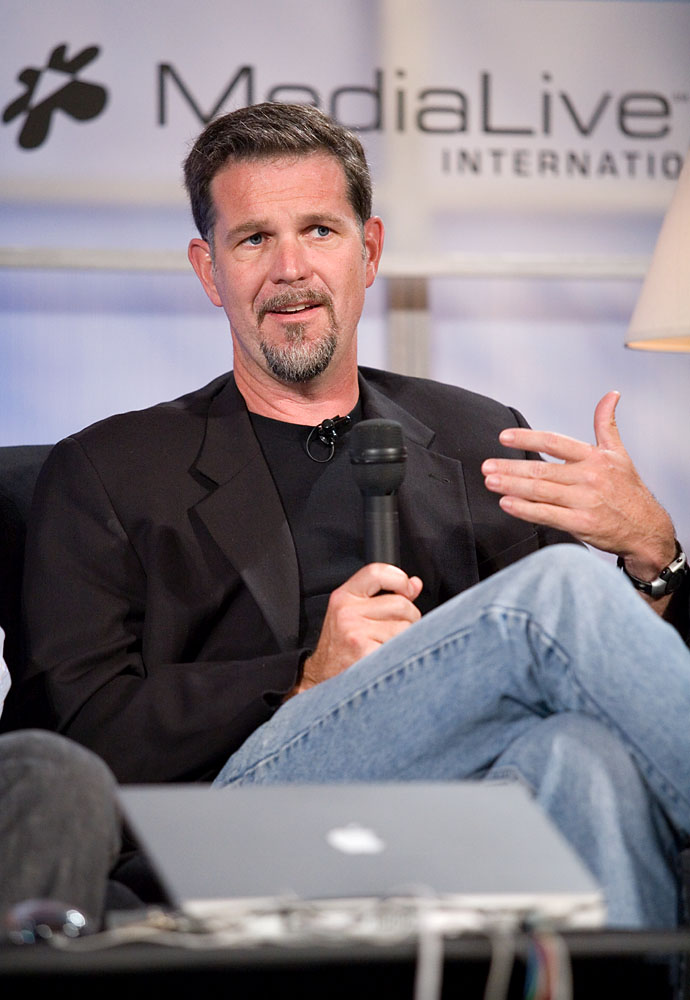 Photo: Wikimedia Commons. CC BY 2.0.
The Science of Secrets
Netflix’s transparency obsession isn’t just philosophical — it’s grounded in research. Hastings cites Michael Slepian, a professor at Columbia Business School, whose research shows that the average person keeps thirteen secrets, five of which they’ve never shared with anyone. There’s a 47% chance one of your secrets involves a violation of trust, a 60% chance it involves a lie or financial impropriety, and a 33% chance it involves a hidden relationship or workplace unhappiness.
I think the reason I keep writing about founders is that I am still trying to answer the question my hosting company could not: what separates the companies that grow from the ones that do not? After a hundred articles, my best answer is: the founder — and specifically the founder willing to open the books. It was always the founder.
Secrets take a psychological toll: stress, anxiety, depression, loneliness. They consume cognitive bandwidth. One study showed people spend twice as much time thinking about their secrets as they do actively concealing them.
But when you share a secret, the effect on the recipient is powerful. As Hastings puts it: “If I tell you some huge mistake I made or share information that could sabotage my success, you think, ‘Well, if she’d tell me that, she’d tell me anything.’ Your trust in me skyrockets.”
What Netflix Won’t Share
The system has boundaries. Netflix is transparent within the company but not about its employees to the outside world. They don’t disclose individual viewer data. They don’t share employee names in firing discussions. And for safety-critical functions — financial reporting to Wall Street, employee harassment claims — Netflix uses rules and process, not freedom and responsibility.
As Hastings explains: “When a mistake would lead to disaster, rules with process is the way to go. We want Netflix to be like a hospital where five people verify the surgeon is operating on the correct knee.”
It’s Jazz, Not a Symphony
The conclusion of No Rules Rules offers the perfect metaphor. Erin Meyer compares Netflix’s culture to the Arc de Triomphe roundabout in Paris — twelve boulevards feeding into an unmarked ten-lane circle with one rule: yield to those already on the roundabout. No lanes. No traffic lights. Total chaos from above — but Meyer’s French husband insists it’s the fastest traffic system in Paris.
Hastings extends this to music: most companies are symphonies — a conductor leads, musicians follow sheet music, precision is the goal. Netflix is a jazz band — the musicians know the structure of the song but have the freedom to improvise, riffing off each other, creating something no conductor could have planned.
“A symphony isn’t what you’re going for. Leave the conductor and the sheet music behind. Build a jazz band instead.” — Reed Hastings, No Rules Rules
The transparency — the open books, the shared financials, the unfinished chapters sent to 700 people — is what makes the jazz possible. You can’t improvise if you don’t know what key the band is playing in. Netflix’s radical openness gives every musician the context they need to play their part without waiting for the conductor’s baton.
For anyone who leads a team: the question isn’t whether to be transparent. It’s whether you trust your people enough to try. Netflix does. And the music they make speaks for itself.
Sources
- Reed Hastings and Erin Meyer, No Rules Rules: Netflix and the Culture of Reinvention, Penguin Press, 2020 (Chapter 5: Open the Books; Conclusion)